Our first full day is off an running, with a quick stop back at the hotel for a shower and change.
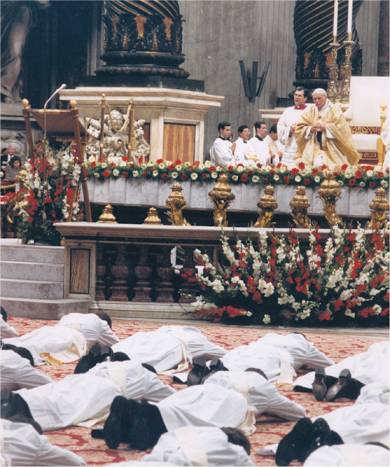
We started with Mass at the Holy Spirit Church near St. Peter's. It is the Church run by St. Faustina's order here in Rome, so a league shrine to Divine Mercy. As we entered, the priest was finishing the chaplet in Italian.
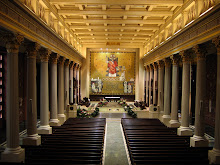
After Mass, we walked to the Vatican Museum and did the quick tour there and ended with a visit to St. Peter's, including a visit to the tomb of Pope John Paul II.
It is always so impressive to appreciate the scale of that building, built 500 years ago at that, wow. Today was 'cleaning day,' so imagine my shock when there were three men standing on the Main Altar. They were changing the candlesticks, with the candles themselves nearly five feet tall.
After our break, a few of our group are going to the residence of the US Ambassador to the Vatican for a reception before going to the Basilica of St. Paul's for Evening Prayer with the Holy Father.
I can't wait!
- Posted using BlogPress from my iPhone
Monday, June 28, 2010

Sunday, June 27, 2010
Greetings from Rome!
After a long two days of travel, we have made it to our respective Hotels, well one group is still to arrive. So far, all luggage is here and accounted for, folks are tired, but excited. we joined the Italian Mass at the Church of St. Ann for tonight's liturgy with dinner at the Hotel, and now an accordion is serenading someone across the street, gotta love Rome!
Tomorrow is Mass at the Holy Spirit Chapel, which i just found out I'm preaching, tour of the Vatican Museums and St. Peter's, some free time and Evening Prayer with te Pope at St. Paul's.
Now, let's hope this posts!
(update: wireless isn't free, so combing when posts update.)
- Posted using BlogPress from my iPhone
Tomorrow is Mass at the Holy Spirit Chapel, which i just found out I'm preaching, tour of the Vatican Museums and St. Peter's, some free time and Evening Prayer with te Pope at St. Paul's.
Now, let's hope this posts!
(update: wireless isn't free, so combing when posts update.)
- Posted using BlogPress from my iPhone
Saturday, June 26, 2010
Almost lift off time....
T-minus six hours till lift off for the Eternal City. Bags are packed, everything is ready to go, just some time to wait, watch a Soccer match, Mass and lunch with the friend who is taking me to the airport, and voilà, tomorrow, Rome! (after that ever convenient Cincinnati-Chicago-Munich-Rome flight path, but hey I can get a weisswurst on that second layover)
Please be assured of my prayers for you, please keep all of us in your prayers as well.
I have heard that the Pallium Mass will be broadcast on EWTN and Catholic TV, but at something like 3:00 in the morning on Tuesday. Hopefully there will be a replay later in the day.
Ciao!
Please be assured of my prayers for you, please keep all of us in your prayers as well.
I have heard that the Pallium Mass will be broadcast on EWTN and Catholic TV, but at something like 3:00 in the morning on Tuesday. Hopefully there will be a replay later in the day.
Ciao!
Wednesday, June 23, 2010
Just a test
I'm trying out a blogging plugin for the new toy which i hope to take with me next week.
The Pali-what?

Tricia Hempel, Editor of the Catholic Telegraph of Cincinnati, has a short piece on the history and meaning of the Pallium, which Archbishop Schnurr recieves next week from the Holy Father.
A snippet:
When the pallia are completed, they are brought to St. Peter’s Basilica. On June 28, the Vigil of Sts. Peter and Paul, they are blessed and remain overnight at the altar where St. Peter’s tomb lies.
The garment symbolizes an archbishop’s participation in the pastoral work of the pope and his apostolic succession. If an archbishop is assigned to another archdiocese, he must petition the pope for a new pallium.
References in writing to the pallium appeared as long ago as the early third century, but its use among Western archbishops did not become common until the ninth century.
As a pastoral symbol, the pallium is worn only by the pope and by archbishops who are metropolitans of ecclesiastical provinces; archbishops who serve as secretaries of Vatican congregations or as Vatican ambassadors around the globe do not receive one. The garment is intended to symbolize the authority of a metropolitan archbishop and his communion with the Holy See. It’s usually only worn at formal liturgical occasions within an archdiocese, such as an ordination.
Tuesday, June 22, 2010
Who's making the trip?
The Vatican Information Service Blog has released the names of the 38 metropolitan archbishops who will be receiving the pallium at Mass with the Holy Father on the Solemnity of Sts. Peter and Paul next week. It will truly be an experience of the universal Church, with reps from all five continents.
On the list are three Americans:
Archbishop Listecki of Milwaukee
Archbishop Wenski of Miami and
Archbishop Schnurr of Cincinnati
(There might be some joke about two Poles and a German going to the Eternal City, but I'm not sure....)
Ok, I am officially getting rev'ed up to go, and working this week is becoming increasingly difficult.
On the list are three Americans:
Archbishop Listecki of Milwaukee
Archbishop Wenski of Miami and
Archbishop Schnurr of Cincinnati
(There might be some joke about two Poles and a German going to the Eternal City, but I'm not sure....)
Ok, I am officially getting rev'ed up to go, and working this week is becoming increasingly difficult.
Monday, June 21, 2010
"Won" by Christ
Join host Brian Patrick and me for our final installment of the Holy Thursday Letters to Priests this Wednesday at 8:40 AM on 740 AM, Sacred Heart Radio.
We have come to the end of Pope John Paul's papacy and his final letter to priests, 2005.
A snippet:
(7b) Particularly in the context of the new evangelization, the people have a right to turn to priests in the hope of "seeing'' Christ in them (cf. Jn 12:21). The young feel the need for this especially; Christ continues to call them, to make them his friends and to challenge some to give themselves completely for the sake of the Kingdom. Vocations will certainly not be lacking if our manner of life is truly priestly, if we become more holy, more joyful, more impassioned in the exercise of our ministry. A priest "won'' by Christ (cf. Phil 3:12) more easily "wins" others, so that they too decide to set out on the same adventure.
We have come to the end of Pope John Paul's papacy and his final letter to priests, 2005.
A snippet:
(7b) Particularly in the context of the new evangelization, the people have a right to turn to priests in the hope of "seeing'' Christ in them (cf. Jn 12:21). The young feel the need for this especially; Christ continues to call them, to make them his friends and to challenge some to give themselves completely for the sake of the Kingdom. Vocations will certainly not be lacking if our manner of life is truly priestly, if we become more holy, more joyful, more impassioned in the exercise of our ministry. A priest "won'' by Christ (cf. Phil 3:12) more easily "wins" others, so that they too decide to set out on the same adventure.
Thursday, June 17, 2010
Elijah and Elisha
The readings over the last week or so have focused on the prophetic mission of Elijah the Prophet. (If you have to go to Heaven, might as well go in the Fiery Chariot, eh?)
In today's First Reading, the Church presents for us the reflections of the author of the Book of Sirach on this great prophet and his successor:
Like a fire there appeared the prophet Elijah
whose words were as a flaming furnace.
Their staff of bread he shattered,
in his zeal he reduced them to straits;
By the Lord’s word he shut up the heavens
and three times brought down fire.
How awesome are you, Elijah, in your wondrous deeds!
Whose glory is equal to yours?
You brought a dead man back to life
from the nether world, by the will of the LORD.
You sent kings down to destruction,
and easily broke their power into pieces.
You brought down nobles, from their beds of sickness.
You heard threats at Sinai,
at Horeb avenging judgments.
You anointed kings who should inflict vengeance,
and a prophet as your successor.
You were taken aloft in a whirlwind of fire,
in a chariot with fiery horses.
You were destined, it is written, in time to come
to put an end to wrath before the day of the LORD,
To turn back the hearts of fathers toward their sons,
and to re-establish the tribes of Jacob.
Blessed is he who shall have seen you
And who falls asleep in your friendship.
For we live only in our life,
but after death our name will not be such.
O Elijah, enveloped in the whirlwind!
Then Elisha, filled with the twofold portion of his spirit,
wrought many marvels by his mere word.
During his lifetime he feared no one,
nor was any man able to intimidate his will.
Nothing was beyond his power;
beneath him flesh was brought back into life.
In life he performed wonders,
and after death, marvelous deeds.
Listening to these words at Mass this morning, I thought that they might make for a good 'eulogy' for a priest, that many marvels are wrought by his words; that the spiritually dead are brought back to life through his administration of the Sacraments, that he not be intimidated by the esteem of others, etc.
Pray that I might make it even close to this one day.
In today's First Reading, the Church presents for us the reflections of the author of the Book of Sirach on this great prophet and his successor:
Like a fire there appeared the prophet Elijah
whose words were as a flaming furnace.
Their staff of bread he shattered,
in his zeal he reduced them to straits;
By the Lord’s word he shut up the heavens
and three times brought down fire.
How awesome are you, Elijah, in your wondrous deeds!
Whose glory is equal to yours?
You brought a dead man back to life
from the nether world, by the will of the LORD.
You sent kings down to destruction,
and easily broke their power into pieces.
You brought down nobles, from their beds of sickness.
You heard threats at Sinai,
at Horeb avenging judgments.
You anointed kings who should inflict vengeance,
and a prophet as your successor.
You were taken aloft in a whirlwind of fire,
in a chariot with fiery horses.
You were destined, it is written, in time to come
to put an end to wrath before the day of the LORD,
To turn back the hearts of fathers toward their sons,
and to re-establish the tribes of Jacob.
Blessed is he who shall have seen you
And who falls asleep in your friendship.
For we live only in our life,
but after death our name will not be such.
O Elijah, enveloped in the whirlwind!
Then Elisha, filled with the twofold portion of his spirit,
wrought many marvels by his mere word.
During his lifetime he feared no one,
nor was any man able to intimidate his will.
Nothing was beyond his power;
beneath him flesh was brought back into life.
In life he performed wonders,
and after death, marvelous deeds.
Listening to these words at Mass this morning, I thought that they might make for a good 'eulogy' for a priest, that many marvels are wrought by his words; that the spiritually dead are brought back to life through his administration of the Sacraments, that he not be intimidated by the esteem of others, etc.
Pray that I might make it even close to this one day.
Two things from this week's Catholic Telegraph
First, Archbishop Schnurr has a great article on Immigration Reform that is not to be missed:
Snippet:
In response, I hope that I can offer some clarification about the church’s teaching and position on this issue. In addition, I pray that these reflections offer you some insights for your own grappling with this difficult and often controversial issue.
One of the fundamental principles behind any moral immigration system is that nations have the right to protect their own borders. Governments have a duty to achieve the common good of the citizens whom they represent. And, in turn, residents of any land have a duty to respect the rule of law. To that end, the U.S. bishops want to see to it that our country has an orderly process that sensibly regulates the flow of migrants and keeps us safe from threats of terrorism, violence, drug trafficking and other criminal activities.
At the same time, the Catholic Church also teaches that all human beings have a right to migrate. First and foremost, every one of us, as a child of God and regardless of our national affiliation, has a right to work to provide for ourselves and our family. Ideally, we should be able to find work in our own countries. However, if such work cannot be found at home, what choice do we have other than to go wherever we can find our livelihood? Any responsible person, charged with the holy work of sustaining life, our own life and the lives of our family members, has a right and duty to migrate if that is the only option.
So how does a nation responsibly balance the right and duty to protect our borders with the right and duty to migrate? How do we live up to the commands of Scripture, where God states, “The strangers who sojourn with you shall be to you as the natives among you, and you shall love them as yourself; for you were strangers in the land of Egypt” (Leviticus 19:33-34)? Remembering always that the Holy Family, fleeing persecution in its own land, was also a migrant family, how do we today unfurl the welcome mat to Christ present in the thousands of immigrants coming to the doorstep and still keep our own house orderly and safe?
It is first important to remind ourselves that most of the laws that define our system today did not even exist before the 20th century. Moreover, they have been amended and changed over time in order to seek this difficult balance.
Secondly, Fr. Earl Fernandes, Academic Dean at Mount St. Mary's stole the topic for my next article:
Snippet:
With respect to the teaching authority of the church’s magisterium, many overlook, or even resent, the pastoral chair, viewing the exercise of authority as “bullying” rather than serving. On June 29, the feast of Saints Peter and Paul, Archbishop Dennis Schnurr and other metropolitan archbishops will receive the pallium from the pontiff. The pallium is a liturgical vestment, woven of white lamb’s wool from sheep blessed by the pope.
The pallium is a reminder of the pastoral chair. The pallium is worn over the shoulders and is a symbol of the gentle yoke of Christ. The lamb’s wool of the pallium represents the lost, sick, or weak sheep whom the shepherd places on his shoulders and carries to the waters of life. The bishop who teaches what Christ taught leads those who have lost sight of the truth, who have grown sick through sin and false teaching and who have grown weak by being fed stones rather than bread, the path to life. Christ is not indifferent to His flock amid the false teaching of “wolves in sheep’s clothing.” Unlike shepherds who lead the sheep to the slaughter, Christ, the Good Shepherd, became a lamb, standing with the downtrodden with His prophetic voice and His challenging and authoritative teaching.
Christ’s love for His flock led Him to call the apostles to himself and to give them authority to preach and teach in His name. Our bishops today are successors to the apostles. It is Christ who established this hierarchy within His church for the worship of God and the care of God’s flock. The teaching of the magisterium, like that of Christ, does not seek to dominate and control but to lead us to life.
Is this teaching challenging at times? Of course, but without it, would we find the “waters of life” or be lost in the “desert?” Today some immediately view magisterial teaching with skepticism, voicing the opinion that it is oppressive. A better disposition might be to listen for the voice of the Good Shepherd in the teaching.
Make sure to read the entire articles.
Now, what do I write about......
Snippet:
In response, I hope that I can offer some clarification about the church’s teaching and position on this issue. In addition, I pray that these reflections offer you some insights for your own grappling with this difficult and often controversial issue.
One of the fundamental principles behind any moral immigration system is that nations have the right to protect their own borders. Governments have a duty to achieve the common good of the citizens whom they represent. And, in turn, residents of any land have a duty to respect the rule of law. To that end, the U.S. bishops want to see to it that our country has an orderly process that sensibly regulates the flow of migrants and keeps us safe from threats of terrorism, violence, drug trafficking and other criminal activities.
At the same time, the Catholic Church also teaches that all human beings have a right to migrate. First and foremost, every one of us, as a child of God and regardless of our national affiliation, has a right to work to provide for ourselves and our family. Ideally, we should be able to find work in our own countries. However, if such work cannot be found at home, what choice do we have other than to go wherever we can find our livelihood? Any responsible person, charged with the holy work of sustaining life, our own life and the lives of our family members, has a right and duty to migrate if that is the only option.
So how does a nation responsibly balance the right and duty to protect our borders with the right and duty to migrate? How do we live up to the commands of Scripture, where God states, “The strangers who sojourn with you shall be to you as the natives among you, and you shall love them as yourself; for you were strangers in the land of Egypt” (Leviticus 19:33-34)? Remembering always that the Holy Family, fleeing persecution in its own land, was also a migrant family, how do we today unfurl the welcome mat to Christ present in the thousands of immigrants coming to the doorstep and still keep our own house orderly and safe?
It is first important to remind ourselves that most of the laws that define our system today did not even exist before the 20th century. Moreover, they have been amended and changed over time in order to seek this difficult balance.
Secondly, Fr. Earl Fernandes, Academic Dean at Mount St. Mary's stole the topic for my next article:
Snippet:
With respect to the teaching authority of the church’s magisterium, many overlook, or even resent, the pastoral chair, viewing the exercise of authority as “bullying” rather than serving. On June 29, the feast of Saints Peter and Paul, Archbishop Dennis Schnurr and other metropolitan archbishops will receive the pallium from the pontiff. The pallium is a liturgical vestment, woven of white lamb’s wool from sheep blessed by the pope.
The pallium is a reminder of the pastoral chair. The pallium is worn over the shoulders and is a symbol of the gentle yoke of Christ. The lamb’s wool of the pallium represents the lost, sick, or weak sheep whom the shepherd places on his shoulders and carries to the waters of life. The bishop who teaches what Christ taught leads those who have lost sight of the truth, who have grown sick through sin and false teaching and who have grown weak by being fed stones rather than bread, the path to life. Christ is not indifferent to His flock amid the false teaching of “wolves in sheep’s clothing.” Unlike shepherds who lead the sheep to the slaughter, Christ, the Good Shepherd, became a lamb, standing with the downtrodden with His prophetic voice and His challenging and authoritative teaching.
Christ’s love for His flock led Him to call the apostles to himself and to give them authority to preach and teach in His name. Our bishops today are successors to the apostles. It is Christ who established this hierarchy within His church for the worship of God and the care of God’s flock. The teaching of the magisterium, like that of Christ, does not seek to dominate and control but to lead us to life.
Is this teaching challenging at times? Of course, but without it, would we find the “waters of life” or be lost in the “desert?” Today some immediately view magisterial teaching with skepticism, voicing the opinion that it is oppressive. A better disposition might be to listen for the voice of the Good Shepherd in the teaching.
Make sure to read the entire articles.
Now, what do I write about......
Wednesday, June 16, 2010
Tuesday, June 15, 2010
A Witness to Faith
Sandro Magister has an excellent commentary on the Holy Father's 'rethinking' of clerical celibacy. No, he isn't doing away with it, but rather giving priestly celibacy a deeper theological foundation to help ground the understanding of the necessity of priestly celibacy not in a pragmatism, but as an eschatological sign of the Kingdom of God. Celibacy marks out the priest as totally God's, and as such is a sign for the rest of the faithful and for the world.
Be sure to read the whole post, which also includes the Holy Father's comments on Vocations, further reflections on priestly celibacy and other remakrs given to priests over the last week as well.
A snippet:
It is the speech that he addressed to the Roman curia on December 22, 2006, commenting on his travels outside of Italy that year.
(snip)
"Celibacy, in force for Bishops throughout the Eastern and Western Church and, according to a tradition that dates back to an epoch close to that of the Apostles, for priests in general in the Latin Church, can only be understood and lived if is based on this basic structure. The solely pragmatic reasons, the reference to greater availability, is not enough: such a greater availability of time could easily become also a form of egoism that saves a person from the sacrifices and efforts demanded by the reciprocal acceptance and forbearance in matrimony; thus, it could lead to a spiritual impoverishment or to hardening of the heart. The true foundation of celibacy can be contained in the phrase: 'Dominus pars' – You are my land. It can only be theocentric. It cannot mean being deprived of love, but must mean letting oneself be consumed by passion for God and subsequently, thanks to a more intimate way of being with him, to serve men and women, too.
"Celibacy must be a witness to faith: faith in God materializes in that form of life which only has meaning if it is based on God. Basing one's life on him, renouncing marriage and the family, means that I accept and experience God as a reality and that I can therefore bring him to men and women. Our world, which has become totally positivistic, in which God appears at best as a hypothesis but not as a concrete reality, needs to rest on God in the most concrete and radical way possible. It needs a witness to God that lies in the decision to welcome God as a land where one finds one's own existence.
"For this reason, celibacy is so important today, in our contemporary world, even if its fulfilment in our age is constantly threatened and questioned. A careful preparation during the journey towards this goal and persevering guidance on the part of the Bishop, priest friends and lay people who sustain this priestly witness together, is essential. We need prayer that invokes God without respite as the Living God and relies on him in times of confusion as well as in times of joy. Consequently, as opposed to the cultural trend that seeks to convince us that we are not capable of making such decisions, this witness can be lived and in this way, in our world, can reinstate God as reality."
Be sure to read the whole post, which also includes the Holy Father's comments on Vocations, further reflections on priestly celibacy and other remakrs given to priests over the last week as well.
A snippet:
It is the speech that he addressed to the Roman curia on December 22, 2006, commenting on his travels outside of Italy that year.
(snip)
"Celibacy, in force for Bishops throughout the Eastern and Western Church and, according to a tradition that dates back to an epoch close to that of the Apostles, for priests in general in the Latin Church, can only be understood and lived if is based on this basic structure. The solely pragmatic reasons, the reference to greater availability, is not enough: such a greater availability of time could easily become also a form of egoism that saves a person from the sacrifices and efforts demanded by the reciprocal acceptance and forbearance in matrimony; thus, it could lead to a spiritual impoverishment or to hardening of the heart. The true foundation of celibacy can be contained in the phrase: 'Dominus pars' – You are my land. It can only be theocentric. It cannot mean being deprived of love, but must mean letting oneself be consumed by passion for God and subsequently, thanks to a more intimate way of being with him, to serve men and women, too.
"Celibacy must be a witness to faith: faith in God materializes in that form of life which only has meaning if it is based on God. Basing one's life on him, renouncing marriage and the family, means that I accept and experience God as a reality and that I can therefore bring him to men and women. Our world, which has become totally positivistic, in which God appears at best as a hypothesis but not as a concrete reality, needs to rest on God in the most concrete and radical way possible. It needs a witness to God that lies in the decision to welcome God as a land where one finds one's own existence.
"For this reason, celibacy is so important today, in our contemporary world, even if its fulfilment in our age is constantly threatened and questioned. A careful preparation during the journey towards this goal and persevering guidance on the part of the Bishop, priest friends and lay people who sustain this priestly witness together, is essential. We need prayer that invokes God without respite as the Living God and relies on him in times of confusion as well as in times of joy. Consequently, as opposed to the cultural trend that seeks to convince us that we are not capable of making such decisions, this witness can be lived and in this way, in our world, can reinstate God as reality."
Others, a divine preference for stone
The best commentary I've seen so far on the, ummm.... tragedy?, of the 'King of Kings' (aka 'Big Butter Jesus' or 'Touchdown Jesus') statue destroyed by lightning strike outside Solid Rock Church, pictured above (before and after, I think it's obvious which is which!), is over at Ignatius Insight by Mark Brumley. His conclusion:
There may indeed be a grander purpose in the destruction of the fiberglass statue of the Lord. But who can say? One church member declared it a call to repentance. Of course since most of us usually have something to repent of or to repent more deeply of, the destruction of the statues certainly can be taken as a providential reminder to turn away from sin.
Iconoclasts will, no doubt, see this as a divine judgment against idolatry. Others might interpret it as a divine preference for stone.
As a 'full disclosure' aspect, I drive by this statue constantly, on my way up and down I-75 between Cincinnati and Dayton, Ohio. As other commentators have noted (and now I can't find), not my preference for religious art, but I admired their zeal in displaying the thing and I tried to remember to say a prayer as I drove past.
It's Getting Closer
This time of year, residents of several Archdioceses throughout the world are making plans for 'The Trip' to accompany a new Metropolitan Archbishop to Rome as he recieves a Pallium from the Holy Father.
Since I don't have a parish assignment, guess what? I get to lead the troops over for this trip with Archbishop Schnurr!
Since we leave in ten days, I am starting to get more and more amped up for it, but the real excitement will not come until I deplane at Leonardo de Vinci Airport and make that bus trip into the Eternal City. I've been four times, but the first time you catch site of St. Peter's... Breathless!
There are about 100 folks heading over from Cincinnati to be with Archbishop Schnurr, and I even know a few, so win-win.
Stops include:
Mass at Sant'Anna in the Vatican City (first time visit for me!)
Vatican Museum and Gallery (a few things I am going to look for that I haven't seen before)
guided tour of St. Peter's
Pallium Mass presided by Pope Benedict
Reception at the North American College
Papal Audience in I think Paul VI Hall
Assisi (never been)
Mass at St. Mary Major and visit to St. John Lateran and the Scalia Sancta
Mass at St. Paul Outside the Walls
San Pietro in Vincolo
Catacombs of St. Callistus and Quo Vadis (my favorite spot in Rome!)
Colosseum and the Forum
That's a lot to pack into 7 days!
Any specific prayer requests?
Since I don't have a parish assignment, guess what? I get to lead the troops over for this trip with Archbishop Schnurr!
Since we leave in ten days, I am starting to get more and more amped up for it, but the real excitement will not come until I deplane at Leonardo de Vinci Airport and make that bus trip into the Eternal City. I've been four times, but the first time you catch site of St. Peter's... Breathless!
There are about 100 folks heading over from Cincinnati to be with Archbishop Schnurr, and I even know a few, so win-win.
Stops include:
Mass at Sant'Anna in the Vatican City (first time visit for me!)
Vatican Museum and Gallery (a few things I am going to look for that I haven't seen before)
guided tour of St. Peter's
Pallium Mass presided by Pope Benedict
Reception at the North American College
Papal Audience in I think Paul VI Hall
Assisi (never been)
Mass at St. Mary Major and visit to St. John Lateran and the Scalia Sancta
Mass at St. Paul Outside the Walls
San Pietro in Vincolo
Catacombs of St. Callistus and Quo Vadis (my favorite spot in Rome!)
Colosseum and the Forum
That's a lot to pack into 7 days!
Any specific prayer requests?
Monday, June 14, 2010
Stop 'Dumbed Down' Catholicism
Having taught Religion in a Catholic School, I tell you that the anecdote he relates is real.
Now, take this as a personal challenge first: develop your own understanding of the faith in all her beauty. (By that, not 'own interpretation,' but make the words and viewpoint of the Church your own, chew on it, digest it, make it a part of yourself.) Then you will be able to give testimony to the joy that is found in living in Christ!
Now, take this as a personal challenge first: develop your own understanding of the faith in all her beauty. (By that, not 'own interpretation,' but make the words and viewpoint of the Church your own, chew on it, digest it, make it a part of yourself.) Then you will be able to give testimony to the joy that is found in living in Christ!
What Priest shortage?

Photo of last Friday's Closing Mass for the Year for Priests.
p.s. Bonus Prize for spotting the 7 Cincinnati priests in attendence....
Subscribe to:
Posts (Atom)


 Posts
Posts