Showing posts with label Tridentine Mass. Show all posts

Sunday, June 5, 2011

Homily from Votive to the Sacred Heart

My homily from Solemn Mass Friday night in the Extraordinary Form, in which I give a bit of a defense as to why I endeavored to undertake such a task:


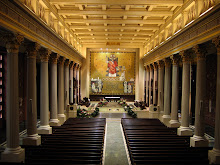
As I begin, I would like to offer a word of thanks and gratitude to Fr. Juarez, pastor here of Old St. Mary’s, for both hosting this monthly Mass and for allowing me to assist over the last few months and to ‘step to the center’ here tonight.  On behalf of many, thank you for making such a beautiful Church available for this liturgy.
    Also, the MC for tonight’s Mass has been invaluable in preparing me for this occasion.  Mr. Paver, thank you for taking the time to walk me through this process, to provide constructive feedback and encouragement; I greatly appreciate it.  As I mentioned to you after the Mass of the Lord’s Supper during Holy Week: this has been a process that has helped to transform my own understanding of the priesthood and the Mass, and I am eternally grateful.
    As I have been preparing for this occasion, I have had, on occasion, a number of questions as to why I, or so many of my brother priests (and seminarians) are desirous of celebrating Mass according to this Rite, or Form.  I wanted to take this opportunity to provide a sort of ‘Apologia’ or defense of striving to do this, for as I just mentioned, this has been a transformative process for me, and I wish for others to understand.
   What initially attracted me to this Form of the Mass, which I first attended while in College Seminary at the Josephinum, was the ‘otherworldliness’ of the approach to the Mass.  To enter into these mysteries is to truly step out of time.  Our physical senses are prevented from fully grasping what is happening so that our spiritual sense might become in tune with the mystery we celebrate: Latin forces the brain to relax and take it in, rather than mindlessly follow a text; the hiddenness of the priest celebrating towards the altar, instead of against the people, stresses that we cannot ‘see’ what is happening, but can only experience; the silence and stillness of so much of what happens might cause a bit of a reaction when we are so used to being engaged in everything that we do, this is somehow different, this is timeless, this is not ‘entertainment,’ this is ‘worship.’  When we confuse those two concepts, we have failed dramatically.
   As a priest, there is even more to it than these.  In the current translation of the Ordinary Form of the Mass, the language that is used is sometimes, umm…., presumptive.  Even after only seven years as a priest, there is an idea that I say those words and it happens.  As a priest, I am not proud to admit, but it can at times be easy to shut the mind off, and just go through the motions.
   When one celebrates this Mass, these two traps: presumption and mindless recitation, are simply not possible.  When I finish celebrating this Mass, even when said privately, I know something has been done.  It takes focus, precision, and dedication to celebrate this Mass well and competently.  When I hear that it was usually said in 12 minutes, rushed through and no homily and very detached from the life of the people, I simply respond: it didn’t have to be.  And, honestly, is the newer form often said much differently?
More importantly, however, is the lack of presumption on the part of the priest.  As I continue to learn the private prayers of the priest of this Mass, I continue to be struck by the, umm…, supplication that is included there-in.  We plead and beg that this Sacrifice which is being offered might be found acceptable to God the Almighty Father, aspects which are sorely lacking in the current Ordinary Form, but will gladly be restored with the implementation of the new translation this coming Advent.
    There is one prayer which I would like to highlight in how it exemplifies this difference, the ‘Placeat tibi’ which said following the dismissal and just prior to the Blessing.  In English, it is rendered:
May the homage of my bounden duty be pleasing to You, O Holy Trinity; and grant that the sacrifice which I, though unworthy, have offered in the sight of Your majesty, may be acceptable to You, and through Your mercy be a propitiation for me and for all those for whom I have offered it.  Through Christ our Lord.  Amen.
As I read and pray this prayer at the end of the Mass, what strives to the fore is the humility required.  The humility required to celebrate this Mass, that it is not about me as a priest, but about worshiping God.  The humility that is required to assist at this Mass, that I am not here to be entertained, but to be united to Christ, and Him Crucified.  The humility that is required for us all to approach our Lord and God in fear and trembling.
   As we approach the implementation of the new translation of the Ordinary From, may the celebration of the Extraordinary Form lead us to a deeper appreciation of the mysteries we celebrate, help us all to approach our Lord in a spirit of humility and prayer, and finally strengthen us all to become more like Christ in this world so that we might be with Him forever in the world to come.

Wednesday, June 1, 2011

A 'How To' for Priests re: the Extraordinary Form

I've been a priest for seven years, now.  Throughout that time, I have wanted to learn to say the Tridentine Mass, aka, Mass in the Extraordinary Form.

As you can see, this Friday, I am ascending to the Altar of God for the first time in a public setting to do so, at a Solemn High Mass.  How can others, who have as little spare time as I do, also make it?  I offer a step by step guide:

1) On days off, if you do not have a 'public Mass,' but for legitimate reasons have a 'Private Mass,' ie: alone or with just a server, say Mass in the NO in Latin.  The prayers are all there in the appendix of the current Missal.  Use the English Presidential Prayers and Readings; everything else in Latin, or as much as you can.  Start w/ just the Eucharisitic Prayer and the acclamations; anything to get the Latin in the brain and on the tongue.  Even without much Latin training, you can do it.

2) Slowly expand.  If at first you have to say the Latin parts silently, so be it.  Start working on pronouncing the parts out loud and getting smoother from word to word, phrase to phrase.  If possible, and you will know the parish, introduce parts to your parish, I would suggest a weekday Mass first, ;)

3) Once you have these parts down, attend a TLM in choir, if at all possible.  You already know where it is happening in your diocese/city, I'm guessing.  They are more than willing to have you take part, even if just sitting there in choir.  WHAT I HEAR FROM PRIEST FRIENDS: 'I wouldn't know what to do!'  My response: You don't have anything TO DO!  (well, besides praying along)  Remember, there is no con-celebration; you literally sit back and get the best show in the house, enjoy it for once!

4) Buy the Big Book, if you don't have it already.  Yep, time to get the 1962 Missal, I would suggest two other things: get the English/Latin Hand Missal, as it is easier to use for the prayers at the foot of the Altar for the start of Mass and has the translations of all the prayers right there on the page, very nice!  2) If you have an ipad, get the iMass app from the Priestly Fraternity of St. Peter.  Same thing: Latin/English on both sides of the page, plus a video up top so that you can follow along w/ the priest as he says the Mass.  I have foung this extremely valuable!  As an added benefit, it loads up the current Mass for the Day, so you can find it in the Big Book, too.  (very helpful!!!)

In your spare time (I know, right), page through the book and get somewhat familiar with it.

5) Next time you are at the EF, stop the MC after Mass (or the presider) and ask: 'Can you help me?'  Anyone worth their salt: Absolutely!  I had the local MC for Una Voce walk me through the Missal and the rubrics for Mass.  At this point, it is helpful to get your own set of Altar Cards, which one can find online and print off.

6) Switch your private Mass from Latin NO to the EF and keep praciticing.

7) Offer to assist as a Deacon or Sub-Deacon at the Solemn High Mass

8) Step to the Center and DO IT!

For me, this was a four to six month process, some days I put in more time (when I had it), some days/weeks, I didn't get any progress made; but I tried to keep an upward trajectory.

This is worth it for your priesthood!!!!! It has helped me to celebrate the NO better, with more reverence.  It has made me appreciate the Mass all the more.  This will also help in appreciating the new texts we will be using this Advent.

As a priest, we get many demands, and this seems like a huge burden to learn and make progress.  Break it down into the steps and timeline that works for you and DO IT!!!

Friday, September 7, 2007

I wasn't there last night...

(at least if anyone asks) but the Priestly Fraternity of St. Peter had the dedication and blessing of Sts. Philomena and Cecelia Catholic Church in Oak Forrest, Indiana. (Oak Forrest is 6 miles outside of Batesville, which is almost as bad as using Botkins, Ohio, as a landmark!)

As is usual, the crowd attending was NOT old timers reliving their youth. It was primarily young families, lots of children, and happy moms and dads. It was an inspiring sight to see.

The Vicar General of the Archdiocese of Indianapolis did the blessing before the Solemn High Mass began. We processed around the outside of the Church first, dousing the place with holy water. After we made our way inside, the interior got a good shot of it as well. The cantor and schola did a marvelous job intoning the psalms and litany of saints.

Fr. Gerard Saguto, FSSP, was the main celebrant for the Mass, as he is administrator of the parish. (He was in the seminary in Cincinnati for a short time before joining the order, hence my connection and invitation.) He certainly knows the Rite well and performed it with all due reverence. I admit, I had to work to follow along. His associate and an FSSP priest down from Indianapolis served as Deacon and Subdeacon.

The homily was delivered by a professor of Fr. Saguto's from Christendom College. He clearly, and scholarly, laid out a strong ecclesiology. I should've been taking notes! (My ecclesiology professor happened to be in attendance as well, oh wait, he wasn't there either!)

My congratulations to Fr. Saguto and the people of Southeast Indiana. It was a very dignified and solemn celebration, but one marked with extreme joy. I was glad to attend.