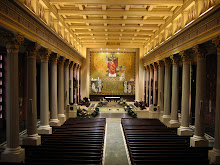
As I write this, the parish where I reside is preparing to say good-bye to a brother priest. Fr. Bob Wolfer had lived in residence at Our Lady of Lourdes in retirement with his brother who was also a priest. Over the last few years, he was in residence at a nursing home prior to being called home by Our Lord here in middle January. I am sad to say that I never really knew either of the Frs. Wolfer, as we were of a different age cohort, and by the time I was on the scene at Our Lady of Lourdes, they were already well into their eighties and needed full time care.
Thursday, January 31, 2013
Good Bye to a Brother Priest
As I write this, the parish where I reside is preparing to say good-bye to a brother priest. Fr. Bob Wolfer had lived in residence at Our Lady of Lourdes in retirement with his brother who was also a priest. Over the last few years, he was in residence at a nursing home prior to being called home by Our Lord here in middle January. I am sad to say that I never really knew either of the Frs. Wolfer, as we were of a different age cohort, and by the time I was on the scene at Our Lady of Lourdes, they were already well into their eighties and needed full time care.
Thursday, October 4, 2012
The only problem is, there are not enough of them!
There is good news to report: the number of seminarians for the Archdiocese of Cincinnati continues to increase, reaching a high water mark since at least the mid 1990's, if not back to the mid 1980's! As this academic year began, we have 45 men in formation for the priesthood for the Archdiocese, 28 of whom are in major theology at Mount St. Mary's Seminary of the West, 17 are in college formation at one of two houses of formation: Bishop Simon Bruté in Indianapolis or the Pontifical College Josephinum in Columbus.
Tuesday, June 19, 2012
New Book to Build the Culture of Vocations
My review:
I was honored to be asked to read a preview copy and submit a review of the work to the author prior to publication. Here is my short synopsis:
'The inner life of a priest is not always easy to describe as both his family history and his experience in ministry affect who he is as a priest. Ms. Boas invites us into the inner life of Fr. Dante as he struggles with his own weaknesses, yet relies on the steel that is underneath as he struggles with the greatest challenge he will face as a priest. She captures him beautifully on paper and I would love to chat with my brother priest in person!'
For those who have read 'Diary of a Country Priest,' you will find the similar internal doubts and struggles that accompany one who has faith. We walk forward into the sometime darkness of our world and what appears to be a chance encounter leads to a chance of a life time.
A great summer read with a truly Catholic worldview and a strong effort to build a culture of Vocations within the Church.
Wednesday, May 23, 2012
Silent No More and Vocations to the Priesthood
Back? Good. A few thoughts, if I might.
I am involved in the Pro-Life Movement. Gladly. I say Mass once a month for the Helpers of God's Precious Infants at Holy Name Church, Mount Auburn. (I'm on 1st Saturday of the Month, 8:00 AM, stop by if you get the chance.) I pray regularly for an end to abortion and the conversion of hearts of those who are in that industry and the lawmakers who shelter and coddle them. I've been to the March for Life, but need to go more often. I am an advisor for Cincinnati Right to Life, where the Pro-Life Movement was founded. (Really, I mean that.)
With all the above, I also recognize that I am not going to be the one who wins the war against abortion on the everyday level. I can't.
However, those who, like the Crescat, come forward after an abortion and admit the terrible and lasting effects that it has had on them in their lives. The depression. The feeling of absolute inadequacy. The imprisonment. The Shame.
I have counseled women who have had abortions, at least initially. It is beyond my limited abilities. I have seen the same pain and turmoil that the Crescat talks about in her post face to face. I have also seen the courage that it takes to publicly admit that mistakes have been made. The fear that paralyzes. The evil one whispering in the ear that 'because of this, you are unloveable.'
It is not so. I look at the Gospels and see the ones Jesus called closest to Himself were not the perfect and the 'Holy,'
Monday, August 16, 2010
The Sacrament of Confession and Vocations
Fr. Bill Baer posted three ways the Sacrament helps to promote vocations:
Specifically, a good confession is the source of a good vocation in at least three ways:
1. God has forgiven me! I recognize His divine, generous, merciful love in this confession, and now my heart wishes to offer generous love toward Him in return.
2. God has forgiven me! Now I wish for others to taste and see this same mercy, perhaps by means of a priestly vocation, through which I might be a channel of God’s ministry of reconciliation to countless others.
3. God has forgiven me! Even though my sins cling to me so closely, and I consider myself far from ready to enter a vocation of celibacy, of religious poverty, chastity, and obedience … nevertheless, I have witnessed Christ Jesus beginning a good work in me in the Sacrament of Reconciliation, a work that might one day be brought to perfection!
These simple statements could not be more true. Any response of a vocation has this same progression:
1) an awareness that, despite one's sins, God still has a powerful and dynamic love for you; and He calls us all to greatness, no matter the vocation.
2) a desire to share: When one experiences this deep and profound Love of God, it is, in a sense, too grand to keep to one's self, it must be shared. This is the example of the saints whose striving for holiness attracted others to imitate them.
3) perfection in Christ: perhaps the most difficult, but slowly the realization dawns, sometimes not until after one is ordained, married, professed, that God is able to marvelous things through you. Not because you are particularly talented or gifted, but rather that the desire has been fostered to echo John the Baptist: HE must increase, I must decrease. In other words, let the Spirit flow where He will, try to stay out of the way and go along for the ride.
Finally, Fr. Baer has these words of wisdom:
If your parish is attempting to promote vocations among your young people, don’t waste your time on slick and silly programs. Get the youth back into God’s good graces. Get them back within earshot of the Holy Spirit.
God does the calling, we have to provide opportunities for Him to meet these young souls, souls in growth, souls open to a unique and powerful Grace. Certainly, the Confessional (in addition to periods of Adoration) is an opportune place for this encounter to happen.
Thursday, August 5, 2010
Wednesday, July 28, 2010
The Heart that Prays is the Heart that Loves
‘In the New Covenant, prayer is the living relationship of the children of God with their Father who is good beyond measure, with his Son Jesus Christ and with the Holy Spirit.’ With these words, from the introduction to the fourth section of the Catechism of the Catholic Church, we are reminded that the life of the Catholic Christian is not simply about blindly following a set of rules, but is ultimately about being drawn deeper into unity with our Triune God.
For those who have read it, this last section of the Catechism is amazingly beautiful, as it is profound. Describing the joys and struggles of personal prayer, as well as the history and development of prayer in the Scriptures and life of the Church, it provides a wonderful basis for all of us wishing to grow in prayer; for left alone, we do not know how to pray as we ought.
While there is much to recommend, I want to focus on one section: paragraphs 2725-2745, entitled ‘The Battle of Prayer.’ Acknowledging that ‘prayer is both a gift of grace and a determined response on our part,’ these paragraphs affirm that prayer is not always easy, sometimes there is dryness in prayer and the heart aches for a response from God, yet only silence is heard. When one experiences such things, it is tempting to think that the method one is using for prayer is wrong or that God has somehow left you alone in the desert to wander on your own.
Rather, it is often the case that God might be asking for strength and discipline in prayer, refining the impure motivations and helping to dispose the heart to be set only on Him. Many of the spiritual masters in our tradition talk of prayer like a muscle, that unless it is exercised, it will atrophy and disintegrate. Then when need arises and one turns to prayer, nothing happens. The will has been so weakened, it is unable to respond, truly a frightening proposition!
But the Catechism gives some helpful guidance in this regard. In the face of difficulty in prayer, the Church calls for vigilance. The bridegroom comes in the middle of the night, and blessed are those who are prepared for his return. This vigilance calls for an attentiveness of heart to the promptings of the Spirit, but the heart will only hear those promptings if it has been conditioned to do so.
The Catechism also highlights temptations found in a lack of faith and acedia. The prior is getting caught up in the cares and concerns of this world, only turning to the Lord as a last resort, highlighted by the phrase: ‘I have tried everything else, I might as well pray.’ Perhaps if we had the habit of praying first, God would help us find the pathway out of this particular mess quicker! Acedia, on the other hand, is becoming too comfortable, a ‘lax ascetical practice.’ In this, the will is not conditioned to deny itself, untrained by fasting and almsgiving; even the smallest temptations are unable to be resisted.
As we grow in prayer, three fruits begin to manifest: trust, hope and charity. The heart that prays trusts in God’s providential care that no matter the storm, the Loving Father will help you to see it through to the end. In essence, ‘Do not tell God how big the storm is, but rather tell the storm how big God is!’ The heart that prays is formed to hope that that there is more here than meets the eye. It recognizes that this world is not all there is, but that there is a paradise awaiting on the other side. Finally, the heart that prays is the heart that loves. It is the power of love for both God and our fellow men that enables the heart conditioned by prayer to persevere over difficulty for the sake of the other, that they too might dwell in God’s Eternal Home in the life to come.
Tuesday, June 15, 2010
A Witness to Faith
Be sure to read the whole post, which also includes the Holy Father's comments on Vocations, further reflections on priestly celibacy and other remakrs given to priests over the last week as well.
A snippet:
It is the speech that he addressed to the Roman curia on December 22, 2006, commenting on his travels outside of Italy that year.
(snip)
"Celibacy, in force for Bishops throughout the Eastern and Western Church and, according to a tradition that dates back to an epoch close to that of the Apostles, for priests in general in the Latin Church, can only be understood and lived if is based on this basic structure. The solely pragmatic reasons, the reference to greater availability, is not enough: such a greater availability of time could easily become also a form of egoism that saves a person from the sacrifices and efforts demanded by the reciprocal acceptance and forbearance in matrimony; thus, it could lead to a spiritual impoverishment or to hardening of the heart. The true foundation of celibacy can be contained in the phrase: 'Dominus pars' – You are my land. It can only be theocentric. It cannot mean being deprived of love, but must mean letting oneself be consumed by passion for God and subsequently, thanks to a more intimate way of being with him, to serve men and women, too.
"Celibacy must be a witness to faith: faith in God materializes in that form of life which only has meaning if it is based on God. Basing one's life on him, renouncing marriage and the family, means that I accept and experience God as a reality and that I can therefore bring him to men and women. Our world, which has become totally positivistic, in which God appears at best as a hypothesis but not as a concrete reality, needs to rest on God in the most concrete and radical way possible. It needs a witness to God that lies in the decision to welcome God as a land where one finds one's own existence.
"For this reason, celibacy is so important today, in our contemporary world, even if its fulfilment in our age is constantly threatened and questioned. A careful preparation during the journey towards this goal and persevering guidance on the part of the Bishop, priest friends and lay people who sustain this priestly witness together, is essential. We need prayer that invokes God without respite as the Living God and relies on him in times of confusion as well as in times of joy. Consequently, as opposed to the cultural trend that seeks to convince us that we are not capable of making such decisions, this witness can be lived and in this way, in our world, can reinstate God as reality."
Thursday, June 10, 2010
Andrew Dinners Continue in Archdiocese
ARCHDIOCESE — Nearly 180 young men have been encouraged to consider the possibility of becoming priests during a series of Andrew Dinners held across the Cincinnati archdiocese over the past year.
There have been eight dinners so far. The first was in April 2009 at Holy Angels Parish in Sidney. The goal is to hold Andrew Dinners in each of archdiocese’s three regions twice a year, said Father Kyle Schnippel, archdiocesan vocations director.
Wednesday, May 12, 2010
Ultimately where God was calling me...
Dayton's News Source :: Top Stories
(be aware there is a teaser that plays prior to the feature on Dan)
(I really despise not being able to embed the video here, grrrr.)
Tuesday, April 20, 2010
For Your Vocation
BISHOPS LAUNCH NATIONAL WEBSITE TO PROMOTE VOCATIONS TO PRIESTHOOD AND CONSECRATED LIFE
'ForYourVocation.org' offers resources for people in discernment
Includes info for parents, teachers, catechists, vocation directors
Efforts respond to Pope Benedict XVI's call to use social media
WASHINGTON-The U.S. Bishops' Secretariat of Clergy, Consecrated Life and Vocations is initiating a new website on April 25 to be a resource for both laity and clergy in the promotion of vocations. The launch date is both the World Day of Prayer for Vocations and Good Shepherd Sunday.
The site has two goals:
To help individuals hear and respond to the call by God to the priesthood or consecrated life, and
To educate all Catholics on the importance of encouraging others through prayer and activities to promote vocations.
The Vocations Website can be found at www.ForYourVocation.org. A Spanish-language site will be available this fall at www.PorTuVocación.org.
Site elements include discernment resources for men and women, respectively, aids for promoting a vocation culture within the home, and a range of tools for educators, youth leaders and vocation directors including prayers, videos, best practices, lesson plans and vocation awareness programs.
In response to Pope Benedict XVI's 2010 Theme for the World Day of Prayer for Vocations, Witness Awakens Vocations, the site also hosts videos of priests and religious men and women giving witness to their vocations, as well as testimonies from family members.
ForYourVocation.org exemplifies the Vatican's embrace of new communications media. In his message for the 44th World Day of Communications, Pope Benedict XVI challenges clergy to employ the "latest generation of audiovisual resources (images, videos, animated features, blogs, websites)" to put the media "ever more effectively at the service of the Word."
The launch of the site will be promoted through social media forums. Facebook users can become "eVangelizers" for the cause. By becoming an eVangelizer, one can connect others to the Website's blog posts.
Dioceses and organizations may link to ForYourVocation.org by following the instructions at http://foryourvocation.org/web-resources.cfm.
Father David L. Toups, S.T.D.
Secretariat of Clergy, Consecrated Life, and Vocations
United States Conference of Catholic Bishops
Wednesday, February 17, 2010
Can I get a witness?
A snippet:
A fundamental element, one which can be seen in every vocation to the priesthood and the consecrated life, is friendship with Christ. Jesus lived in constant union with the Father and this is what made the disciples eager to have the same experience; from him they learned to live in communion and unceasing dialogue with God. If the priest is a "man of God", one who belongs to God and helps others to know and love him, he cannot fail to cultivate a deep intimacy with God, abiding in his love and making space to hear his Word. Prayer is the first form of witness which awakens vocations. Like the Apostle Andrew, who tells his brother that he has come to know the Master, so too anyone who wants to be a disciple and witness of Christ must have "seen" him personally, come to know him, and learned to love him and to abide with him.
Another aspect of the consecration belonging to the priesthood and the religious life is the complete gift of oneself to God. The Apostle John writes: "By this we know love, that he laid down his life for us; and therefore we ought to lay down our lives for the brethren" (1 Jn 3:16). With these words, he invites the disciples to enter into the very mind of Jesus who in his entire life did the will of the Father, even to the ultimate gift of himself on the Cross. Here, the mercy of God is shown in all its fullness; a merciful love that has overcome the darkness of evil, sin and death. The figure of Jesus who at the Last Supper, rises from the table, lays aside his garments, takes a towel, girds himself with it and stoops to wash the feet of the Apostles, expresses the sense of service and gift manifested in his entire existence, in obedience to the will of the Father (cf. Jn 13:3-15). In following Jesus, everyone called to a life of special consecration must do his utmost to testify that he has given himself completely to God. This is the source of his ability to give himself in turn to those whom Providence entrusts to him in his pastoral ministry with complete, constant and faithful devotion, and with the joy of becoming a companion on the journey to so many brothers and sisters, enabling them too to become open to meeting Christ, so that his Word may become a light to their footsteps. The story of every vocation is almost always intertwined with the testimony of a priest who joyfully lives the gift of himself to his brothers and sisters for the sake of the Kingdom of God. This is because the presence and words of a priest have the ability to raise questions and to lead even to definitive decisions (cf. John Paul II, Post-Synodal Apostolic Exhortation Pastores Dabo Vobis, 39).
Thursday, December 10, 2009
The Call of Parents
As we once again journey through the Advent season, at least part of me always wonders what was going through Mary’s mind during that journey. The somewhat haunting refrain of a popular carol asks: ‘Mary did you know that your baby boy would someday walk on water?” “That this child that you delivered will soon deliver you?” While we can never truly know the thoughts of our Blessed Mother, it certainly invites some speculation during the run up to Christmas.
Perhaps the easiest thing to surmise is that her conversation with the Archangel Gabriel was running over and over in her thoughts. From the moment of her conception, she had been prepared to be the Mother of God, and now it was about to happen. She would be responsible to bring Jesus up, to teach Him to pray, and to form Him to be able to accept the mission that had been prepared for Him from the foundations of the world. It is a wonder she had any sleep at all!
Mary and Joseph’s role in raising the child Jesus to fulfill His mandate is something that is shared by all parents. The final blessing of the Rite of Baptism bears this out. In the prayer over the father, they are reminded that the parents “are the first teachers of their child in the ways of faith. May they be, also, the best of teachers, bearing witness to the faith in all that they say and do.”
The Church takes this commissioning of parents very seriously and counts on parents to be the best of teachers, going so far as to call the home the ‘domestic church.’ It is in the home that children are taught to pray, to love and serve God, to overcome difficulty, and, perhaps most importantly, where they are formed to be Christian disciples in this world. It is this call to discipleship where each child, as he or she grows into adolescence and young adulthood, should begin to realize that God has called him or her to do something special, something unique. The mission of parents is to enable their children to accept this God given mission with all their heart, mind and soul.
Despite this commissioning that was received at their child’s Baptism, in my work as Director of Vocations, I sometime run afoul of parents. I will talk with a young man interested in the priesthood or a young woman interested in religious life, and their response is tragic: “Father, I feel called to this, but my parents will not allow it.”
I often wonder what goes into this denial. Perhaps it is a desire for grandchildren on the part of the parents; perhaps it is fear that their son or daughter will be lonely in ministry; perhaps there is a fear of ‘what happens if he does not like the seminary?’ I have a feeling that it is a combination of all three, and truly driven out of love for their child.
To this last, I respond that as much as they love their child (who is now a young adult), God loves him or her even more and if He has placed this on their heart, God will give them the strength and courage to be able to respond. God does not set someone up for failure, but rather gives them the gifts that they need to succeed, just as He gave Mary and Joseph the gifts they needed to be worthy parents of Jesus.
During this Advent season, I invite parents to pray for their children, but not just in a generic way. Rather, pray specifically for two things: help in discerning the unique gift and talent that God has given to each of your children, and how is He asking me to nurture and develop those gifts, so that when this child leaves the home to enter the world, they will do so with the confidence that comes from being a convicted child of God.
Forming our children with these two questions in mind will ultimately lead them to follow wherever God might be leading them in the Church and in the world.
For information on how to share the Faith with your children, see www.cincinnativocations.org
Wednesday, November 11, 2009
Andrew Dinners Report
ST. LAWRENCE DEANERY — The young men enjoying dinner at Our Lady of Lourdes Parish Oct. 28 talked of the usual things high school boys discuss: school, grades and the high school football playoffs.
But these young men also spoke of the seminary and their possible call to the priesthood at the third Andrew Dinner held this fall in the Cincinnati archdiocese. The dinners allow men, mostly juniors and seniors in high school, to learn more about the priesthood.
Eighteen students from the west side of Cincinnati attended the dinner. They were joined by several priests and Coadjutor Archbishop Dennis M. Schnurr.
The evening included a social time, dinner, a presentation and questions and answers. It ended with the praying of the Liturgy of the Hours in the church.
The only question I have is how did Rich beat me to the punch on this one?
Wednesday, September 2, 2009
Vocation Advice
His four points:
1) Emphasize the Vocation of Marriage and Family
2) Re-creat a culture of vocations
3) The laity need not be afraid of asking their priests to help them to be holy
4) Priests must be reminded that they are here to help the laity get to heaven
It's just that simple, no?
Wednesday, July 8, 2009
Go Up to the Altar of God
As the Israelites moved from a nation on the move to settling in cities in the newly conquered Promised Land, one of the first desires was to build a suitable house for the Lord, as David desires in Second Samuel. The People of Israel had been worshiping God in the Tent of Meeting since the time of the Exile some 200 years prior, and now that they were established, a permanent structure was seen as fitting.
However, because David had too much blood on his hands, God chose his son Solomon to build the original Temple in Jerusalem, on the highest mountain within the City of David, where it continues to stand, now under the Dome of the Rock Mosque.
The location that was chosen was not accidental. Throughout the Scriptures, sacrifice is offered to God not in the low places, swamps and marshes; but rather on the mountains so that they could be ‘closer’ to God, at least metaphorically: Noah offers his sacrifice on coming out of the Ark on Mt. Ararat, Abraham ‘sacrifices’ Isaac on Mt. Moriah, Moses’ sacrifice upon Mt. Sinai, and Solomon builds the Temple upon Mt. Zion. This ‘ascent’ represents a lifting of hearts and minds to the God of Heaven and orients us towards the life to come, rather than life here on earth. We can see this reflected in architecture that raises the altar and the main sanctuary in Catholic church buildings so that we, too, may lift our eyes to the Lord.
Worship in the Old Covenant, however, was not just the ‘lifting of eyes to the Lord.’ It was very much centered around sacrifice. Daily in the Temple, at 9:00 am and 3:00 pm, the Tamid would be offered before the Lord. This offering of a lamb, bread and wine was a continual reminder that the People of Israel were to be offered to God. They are marked as God’s Chosen People, and the lamb is symbolic of an offering of self to the Lord God. In this way, all the people participated in Temple worship on a daily basis.
Yet, there was more than one type of sacrifice offered in the Temple, so that while the Tamid was the high point of the day, animals were being offered continually to the Lord through the ministry of the priests, of particular note for our discussion here is the Sin Offering discussed in Leviticus 4. Here, the layman brought an animal before the priest and laid his hands upon it, confessing his sins to the priest as he did so, symbolically placing them upon the head of the sacrifice. The layman then slits the throat and cleans and prepares the animal, which is then presented to the priest. The priest has caught the blood of the animal, and, with the rest of the carcass, burns the sacrifice on behalf of the layman on the Altar of God.
In looking at the Catholic Mass of today, strong parallels leap forward to bring us not just to Jesus’ offering of self on the Cross, but back to the very foundations of sacrifice as instituted by God, through Moses, on Mt. Sinai. God truly has planned this out from the beginning. As we enter into the deep mysteries we celebrate at every Mass, all of history becomes present in an eternal, and now even greater, offering back to God the Father, for it is now the offering of Christ back to His Eternal Father. Reality is never more “real” than in the Eucharist!
Hence, as Catholics, we see the great need for our priests. It is the priest alone who, unworthy though he is, presides at these great cosmic mysteries. Here, he offers not just the bread and wine to be turned to the Body and Blood of Christ, but also himself and his people, who are no longer just chosen, but adopted to be sons and daughters of God, in Christ.
For more information on the priesthood and the Year for Priests, visit www.cincinnativocations.org
Tuesday, March 31, 2009
Wednesday, March 18, 2009
Monday, March 2, 2009
'We could have a little bit better approach.'
Priest recruitment was a priority for you in Duluth, where the number of seminarians tripled on your watch. Will it be a priority here?
"I don't think the Archdiocese of Cincinnati is an exception. It's a very important concern for the church. There are many good programs in the archdiocese that relate to vocations (priest recruitment), but there are places we could have a little bit better approach."
Will you be actively involved in priest recruitment?
"I think it's very important for the archbishop to express an interest in the seminarians. The renewal I experienced from the seminarians in Duluth was nothing less than inspiring."
Why have some Catholics, especially young Catholics, drifted away from the church and from regularly attending Mass?
"What we are experiencing is in part due to the real confusion that followed the Second Vatican Council (a series of reforms in the 1960s). We didn't explain the changes that were taking place, so people became very confused. Because of that confusion, a lot of our Catholics, you might say, threw the baby out with the bath water."
What can you do to bring them back?
"You hear people say we have to establish a culture of vocations, and I agree with that ... The whole idea of God calling can't just be limited to the priesthood. Every single person has a vocation. Everyone has been called to a purpose. One of the most important questions we have to answer in our lives is, 'What has God called me to do?' Until you raise the question - Why did God create me? - there is no understanding and you're not going to pursue that purpose."
Friday, February 13, 2009
The weak are called and made strong through Christ
“Leave me Lord, for I am a sinful man.” With these words, St. Peter tries to dismiss the call that Jesus gives to him in the Gospel according to St. Luke. A hallmark of his, Peter always seems to be aware of the weaknesses that he has. Yet despite his attempt at a dismissal, Jesus will not be swayed and gives Peter the commission that he is to become a ‘fisher of men’.
So many times in my work as vocation director, I hear this sentiment of Peter in the words of a young man who is discerning a call to the priesthood. Troubled by his own past, the young man before me tries to dissuade either Our Lord or himself from his calling: “There is no way that Jesus is calling me to be a priest! I am a sinner and have done too many terrible things.” As we talk through these objections, I sometimes struggle to keep from smiling as I hear echoes of so many saints (and even my own struggles with my call while in the seminary) who have responded to this same call to leave behind everything and follow after Christ.
St. Paul had a massive conversion experience, going from one who actively persecuted the Church to the great Apostle to the Gentiles. Despite his complicity in the martyrdom of St. Stephen, Our Lord called him to take His message to the ends of the world. He struggled with his own worth the rest of his life, calling himself the least of the Apostles for his former ways of persecution did not leave him worthy of the name. His former persecutions even presented challenges among the faithful who doubted his sincerity, yet, called he was.
St. Peter’s moment of weakness during Jesus’ Passion was not his last. On the Via Appia Antiqua in Rome stands the little Quo Vadis? Church. As persecutions grew under Nero, St. Peter grew afraid for his life and left the city along the Appian Way to the south of Italy. As he traveled, he saw Jesus going the other way, back to the city, and asked him incredulously: “Lord, where are you going?” (“Quo Vadis?” in Latin) Jesus looked at Peter and simply replied: “I am going to Rome to be crucified again.” With this simple admonition, Peter returned to Rome to face his own crucifixion, upside down, for he did not feel worthy to die in the same manner that Jesus did.
The list of great saints who have struggled with their own sinfulness continues to our very day, and includes some of the greatest saints we venerate: Jerome, Augustine, Ignatius of Loyola, Maximillian Kolbe. It is important to recognize that Jesus does not call those who are worthy of the priesthood, for no one is truly worthy of this great gift. Rather, he equips those who are called to lay their own weaknesses at His feet, and He gives them the talents and abilities needed to fulfill the mission that Jesus has set before them.
It is important for a man who is being called to the priesthood to recognize that only through Christ is one made strong. As with St. Paul, he is to willingly boast of his weaknesses, for in his weakness is Christ made strong through him. Only through a free gift of self is God able to work these dramatic miracles through those whom He has chosen. To those being called, God knows your weaknesses, after all He created you; but He also knows the grace you need to overcome, this is what will make you strong to serve the Lord.
For information on how to serve the Lord as a priest for the Archdiocese of Cincinnati, visit www.cincinnativocations.org.