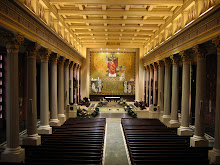
A tradition we have with Theology on Tap, Cincinnati, is to gather after the talk at a nearby parish for some time of adoration. In the past few years, we've gathered at the Cathedral Basilica in Covington, Kentucky, but with a move to Cincinnati's Hyde Park and The Pig and the Whistle, we now gather at Oakley's St. Cecilia Parish, where a classmate of mine is pastor.
Last night, the air was rather think with some humidity and a bit high temperature, so there was some 'weight' to the proceedings. However, as happens under those circumstances, the incense did not rise to the heavens, but rather stayed in a cloud right near the altar. (I have to admit, I did load up the thurible with copious amounts of incense as we started. You know how to tell if there is enough incense being used? If you can't see the back wall, you might have enough.)
As more and more smoke poured out of the thurible, the cloud hovered right above the Altar, growing thicker and thicker. Slowly, whisps of smoke drifted further out into the Nave of the Church, but for the most part, a big cloud hoevered there. Ocassionally, an updraft would surge through the 'cloud' and lift slightly further afield, yet it would hit that heavier layer up above and slowly sink back into the mass of smoke. From where I was kneeling to the side of the Altar, I could see a smaller pillar of cloud rising with the heat of the candles which surrounded the Monstrance, Jesus certainly lifiting our prayers to His Heavenly Father.
However, what struck me in the imagery were two-fold:
1) The Glory Cloud, the Shekenah (sp?) that lead the people of Israel from slavery in Egypt to freedom in the Promised Land, you know: the pillar of fire by night, cloud by day, from Exodus. A sign of God's Providence and leadership of the People, He was the one leading them through their wanderings in the desert. Symbolically, here, last night, He continues to lead us through our pilgrimage of life, not to an eartly paradise, but to a heavenly one.
2) The opaqueness of the Cloud: If I turned to my right to look into the nave from my perch int he sanctuary, I could see clearly. However, as I gazed across the Altar, everything was obscured, hazy, distant almost. This is a second 'end' of using incense in the liturgy. Our physical eyes are obscured, veiled from seeing, so that our spiritual eyes might grasp the deeper reality. When Christ is present on the Altar, we peer into the Heavenly reality. But because we are limited by physical sight, we cannot see things as they truly are, but under the physical appearance so that we might have some insight. By using incense to obscure the physical, our spiritual eyes are allowed to take dominance and we see through the veil the separates this world from the heavenly. We are drawn to our final goal: Eternal Life with Him.
Thank you, Lord, for such a wonderful vision of Your Eternal Banquet!
Showing posts with label Liturgy. Show all posts
Showing posts with label Liturgy. Show all posts
Friday, May 27, 2011

Wednesday, April 21, 2010
Chant Tones and Solemnity
A reader asks:
Does the fact that the chant tones will be provided indicate that we will be expected to use them, or will they just kind of be "there"?
Well, I am not an expert, but I think the general feeling is that they should be used regularly, and that they will provide a good basis for increased solemnity, but much of it will depend on the facility of the preist with chant. (My point: even the most tone deaf man can learn to carry one note, if not just two simple notes.)
Increased Solemnity would be that the 'higher' the feast, the more musical notation and chant should be included. Therefore, Easter Sunday Mass could be sung, in its entirety, start to finish. And because Easter is our highest feast day, there should be a marked increase to singing on that day, with a joyful noise unto the Lord. Lent should be sung, but in more minor tones to reflect the tenor of the season, etc.
However, let's say it is Wednesday, July 28, and there is nothing, nothing, on the calendar. While the Mass parts should be chanted, and the '4 Hymn Sandwich' and/or introits and antiphons should be chanted, to chant the Eucharistic Prayer just because I can, well, that doesn't necessarily reflect 'increased solemnity.'
Then again, I work in the Vocation Office, not the Worship Office. I know Fr. Geoff Drew lurks here every once in a while, he might offer a clarification or comment....
Subscribe to:
Posts (Atom)


 Posts