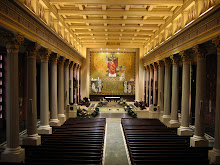
Last night, I was at a meeting of self-identified 'Catholic Geeks.' (One of whom boasts that she can identify every bishop in the line-up processing into the Mass for Life, that's right up there!)
What did we do for fun? Compare the new translations of the Missal with the existing ones. Reading through some of the prayers and new texts, I nearly had tears in my eyes in the way they convey the meaning and significance of the mystery being celebrated on a particular day.
For instance, the Preface for Advent II (which can be found in this PDF):
It is truly right and just, our duty and our salvation,
always and everywhere to give you thanks,
Lord, holy Father, almighty and eternal God,
through Christ our Lord.
For all the oracles of the prophets foretold him,
the Virgin Mother longed for him
with love beyond all telling,
John the Baptist sang of his coming
and proclaimed his presence when he came.
It is by his gift that already we rejoice
at the mystery of his Nativity,
so that he may find us watchful in prayer
and exultant in his praise.
And so, with Angels and Archangels,
with Thrones and Dominions,
and with all the hosts and Powers of heaven,
we sing the hymn of your glory,
as without end we acclaim:
Holy, Holy, Holy Lord God of hosts…
The current translation says: 'John the Baptist was his herald and made Him known when at last he came.'
Now, he 'sings' of his approach. wow.
Also, that ending: 'And so, with Angels and Archangels...we acclaim' is now the normative ending for the preface to lead into the Sanctus. It's always been there, in the Latin, but is an easy highlight to show how the original translators mashed things together in an effort to simplify things.
These new prayers, I think, really do lift the heart. Are there tongue twisters? Yes. The line above: 'It is by his gift that already we rejoice' strikes a bit odd, but it certainly makes one think, no?
Showing posts with label New Missal. Show all posts
Showing posts with label New Missal. Show all posts
Monday, May 16, 2011

Wednesday, April 21, 2010
Chant Tones and Solemnity
A reader asks:
Does the fact that the chant tones will be provided indicate that we will be expected to use them, or will they just kind of be "there"?
Well, I am not an expert, but I think the general feeling is that they should be used regularly, and that they will provide a good basis for increased solemnity, but much of it will depend on the facility of the preist with chant. (My point: even the most tone deaf man can learn to carry one note, if not just two simple notes.)
Increased Solemnity would be that the 'higher' the feast, the more musical notation and chant should be included. Therefore, Easter Sunday Mass could be sung, in its entirety, start to finish. And because Easter is our highest feast day, there should be a marked increase to singing on that day, with a joyful noise unto the Lord. Lent should be sung, but in more minor tones to reflect the tenor of the season, etc.
However, let's say it is Wednesday, July 28, and there is nothing, nothing, on the calendar. While the Mass parts should be chanted, and the '4 Hymn Sandwich' and/or introits and antiphons should be chanted, to chant the Eucharistic Prayer just because I can, well, that doesn't necessarily reflect 'increased solemnity.'
Then again, I work in the Vocation Office, not the Worship Office. I know Fr. Geoff Drew lurks here every once in a while, he might offer a clarification or comment....
Tuesday, April 20, 2010
Review of the Roman Missal Workshop
Last Thursday and Friday, Cincinnati hosted the first of 22 planned workshops on the implementation of the translations of the Third Typical Edition of the Roman Missal. Staffed by the USCCB Committee on Divine Worship and Federation of Diocesan Liturgical Committees, there is always some hesitancy in attending these workshops: what is the slant of the presenters? is there anything new? and of course, the main question: WHEN?????
(If you look at my Twitter Feed you will find some of the links, posted below. This one was my favorite.)
I have to admit that I was plesantly surprised and enjoyed the workshop, as Msgr. Schirman (I think is how he spells his name, exec director of BCDW) lead most of the sessions.
By Session:
#1: A History Lesson. When working with teens, if you do something three times, 'We've ALWAYS done it this way!!!' Well, when it comes to the Mass, we haven't. It is important to stress that the Mass that we pray is found, originally, in Latin, not English. In the development of vernacular texts, primarily in non-IndoEuropean families and smaller language family sets, there was difficulty in finding translators from Latin into whatever language. Instead, they used the English translation. Well, let's just say that didn't work out so well. Every translation is to obscure the text, and to take it two or three steps from the original..... Ever play the Telephone Game around a campfire? This was a good session giving the background and helped concretize the importance of a good translation.
#2: Overview of the Revised Roman Missal. Monsignor walked us through the process of how and why certain translations were chosen, given us a quick, down and dirty, lesson in Latin along the way. Also noting that the guiding principals for translation were changed, now the Latin syntax takes a priority over the vernacular syntax, so we get sometimes awkward phrasing in English which will take some time to truly understand. Another guiding point: everything (as much as possible) that is in the Latin should be present in the vernacular. Admittedly, (especially if you read Fr. Z's blog) the current English prayers are weak (not universally), and the updates should be good.
#3: Music in the New Missal: simply, chant tones will be throughout, including settings for the readings and Gospel, all the dialogues, etc. Two basic tones will be included: Simple and Solemn. I know this will come back to bite me, but the Solemn Tone seems simpler than the Simple Tone, huh? (It's based on the Latin settings.) Again, the Latin priority comes across, as the tones in English will have a similar feel and tone to the Latin tones, think, for example, of the Latin Agnus Dei chant and how easy it is to switch that over to the English setting. This is something that I, in particular, am looking forward to. To have an English and Latin setting of all the Mass parts that people should readily know will be very advantageous, I think.
#4: Leading change. This was admittedly the weakest session of the workshop, and we had quite a game of Buzz Word Bingo going on. Ok, yes, be positive, ok, yes, it is a 'transition', ok, yes, how we lead our people through this will have a great impact, I get it. 45 minutes on this: too much.
#5: Roman Missal Implementation: this was perhaps the most useful of sessions, for the resources given out were of particular importance to help guide this whole process. 'They' have asked for a year after the recognitio from Rome, and there is a suggested schedule starting this whole shebang at least a year out, so again, Advent 2011 looks like the most likely date of implementation, but don't quote me on that, just yet.
Ok, resources:
Roman Missal page from the USCCB
Become One Body, One Spirit in Christ out of Leeds, UK
FDLC has a 'Parish Kit' for sale
Monsignor read extensively from LTP's 'Understanding the Revised Mass Texts'
I just received in the mail a copy of Jeff Pinyan's 'Praying the Mass; The Prayers of the People' which looks like it explains some of the reasons behind the changes (and with your spirit) I'm gonna delve into this the next few days.
I think that's all, and remember: If you think it is going to be hard on the laity, it's going to be worse on the preists!
Wednesday, April 14, 2010
ICEL Tones for the New Translation
ICEL has published some tentative new tones for use by priests in the new translation.
Simple, easy, yet added solemnity.
Simple, easy, yet added solemnity.
Subscribe to:
Posts (Atom)


 Posts