So you still check New Advent daily, right? If not, missing great content!
Today, Good Sir Knight linked to Summa This, Summa That, which is a new blog to me, on 'How to Grow a Priest. It is a reflection on the Pope's recent 'Letter to Seminarians,' and includes the realization of the obvious (which is sometimes the hardest to see):
Here’s something I learned a little too late in life: Faithful priests come from, well, the faithful. The call to the ministerial priesthood grows out of the common priesthood that all the baptized share, since the People of God participate in the Christ’s three offices of priest, prophet and king.
So let us consider just how deeply we live out our own intimacy with Christ. We never know – we may be influencing a future priest in our midst!
Read the rest here.
Showing posts with label discernment. Show all posts
Showing posts with label discernment. Show all posts
Thursday, November 4, 2010

Tuesday, August 3, 2010
Many are Called
The fruits of the 'Year for Priests' continue to ripen on the vine.
One such fruit that I recently had the joy of reading is Dr. Scott Hahn's 'Many are Called: Rediscovering the Glory of the Priesthood.'
In his typical style of weaving both the Old and New Covenant together in a modern language, Dr. Hahn lays out the biblical perspective of the priesthood for the present day. Yet, he also covers many of the current 'hot button' issues, not shying away, but giving a beautiful interpretation of priest as father, mediator, provider, teacher, warrior, judge, bridgegroom, celibate father and brother. (To give the titles of the chapters included.)
Perhaps the best aspect of the book is his weaving together of his own story as a former Presbyterian Pastor, and the difficulties therein, and how his appreciation for a celibate priesthood has grown in his years leading up to and after his conversion. To be a father of a family is to give your life for your children; Dr. Hahn outlines the ways that the priest as celibate father gives life to his spiritual family, in both spiritual and material ways.
But at the bottom line, he articulates that which every priest recognizes: the priest is a regular man, called to something greater. Why is it that God calls certain men and not others? We will never know (at least on this side of the curtain), but yet this is how God's plan of salvation continues to be worked out in the Church and in the world.
I would highly recommend this book for those discerning a call to the priesthood, as well as for a parish adult faith formation group who would like to come to a deeper understanding of aspects of the Catholic Priesthood that so often are maligned or misunderstood.
Dr. Hahn's website is here.
Purchase the book from Barnes and Noble here.
One such fruit that I recently had the joy of reading is Dr. Scott Hahn's 'Many are Called: Rediscovering the Glory of the Priesthood.'
In his typical style of weaving both the Old and New Covenant together in a modern language, Dr. Hahn lays out the biblical perspective of the priesthood for the present day. Yet, he also covers many of the current 'hot button' issues, not shying away, but giving a beautiful interpretation of priest as father, mediator, provider, teacher, warrior, judge, bridgegroom, celibate father and brother. (To give the titles of the chapters included.)
Perhaps the best aspect of the book is his weaving together of his own story as a former Presbyterian Pastor, and the difficulties therein, and how his appreciation for a celibate priesthood has grown in his years leading up to and after his conversion. To be a father of a family is to give your life for your children; Dr. Hahn outlines the ways that the priest as celibate father gives life to his spiritual family, in both spiritual and material ways.
But at the bottom line, he articulates that which every priest recognizes: the priest is a regular man, called to something greater. Why is it that God calls certain men and not others? We will never know (at least on this side of the curtain), but yet this is how God's plan of salvation continues to be worked out in the Church and in the world.
I would highly recommend this book for those discerning a call to the priesthood, as well as for a parish adult faith formation group who would like to come to a deeper understanding of aspects of the Catholic Priesthood that so often are maligned or misunderstood.
Dr. Hahn's website is here.
Purchase the book from Barnes and Noble here.
Tuesday, July 6, 2010
This is just what priests do.
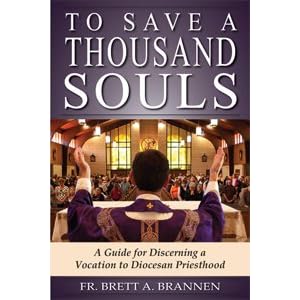
On the flight back from Rome, I had the chance to read through (finally) Fr. Brett Brannen's excellent new work: 'To Save a Thousand Souls: A Guide for Discerning a Vocation to Diocesan Priesthood.' As a Vocation Director, this is the tool I've been looking for in helping men discern the priesthood.
A former vocation director and now director of formation at Mount St. Mary's Seminary in Emmitsburg, Maryland, Fr. Brannen has a unique insight into what it takes to make for a successful vocation to the priesthood, steering young men (and perhaps not so young) through the sometimes difficult and complicated maze of discernment, with clear and practical ideas.
Beginning with personal anecdotes of his priesthood, he starts in a very positive light that shows the impact one priest can have on a family, a village, a country and the world. Moving on, he outlines basic steps for discernment, spiritual direction, virtue, dealing with parents, celibacy and cheerfulness all the way up to daily life in a seminary of today and the new priest's ordination day.
Acknowledging that a vocation is only heard in prayer, he also provides rosary meditations for those discerning a call to the priesthood.
Chapters 9 (The Seven Stages of a Diligent Discernment) and 10 (Practical Ideas for Discerning Diocesan Priesthood) provide clear and concise steps in discernment, such as 'God can't drive a parked car, it's time to move!' 'say three Hail Mary's every day,' Pray before the Blessed Sacrament,' 'write down the pros and cons of marriage and priesthood,' 'do a 'what can't I live without' exercise,' and many more.
In short, I certainly learned a great deal to help in my work, and men discerning will certainly benefit greatly from this work.
Thursday, October 15, 2009
The Experience of 'The Call'
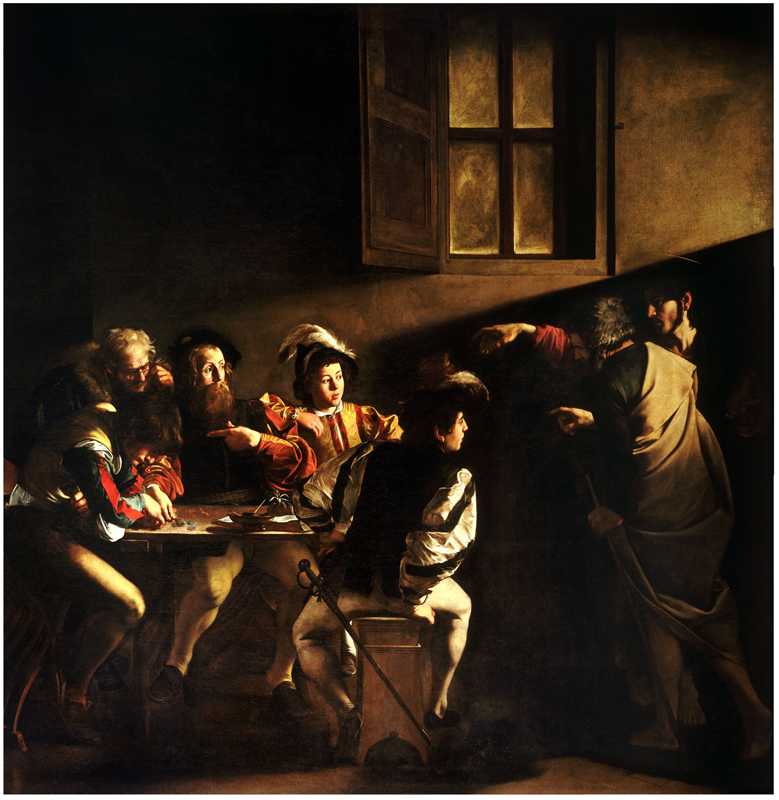
Known for the way he developed the interplay between light and darkness in his paintings, the Italian master Caravaggio has had a lasting impact in the world of art since his troubled life ended nearly 400 years ago. His distinctive paintings, especially his religious scenes, continue to have an impact even on today’s viewers.
For me, his ‘Calling of St. Matthew’ resonates. Commissioned by Cardinal Matteu Contreil to hang in the French National Church of San Luigi dei Francesi in Rome, the scene draws you in as a nearly hidden Christ points powerfully to St. Matthew, sitting at his post as a tax collector. Jesus is not content to let Matthew remain and powerfully beckons him to follow, to become one of the Twelve, to become an Evangelist. The faces of those seated with St. Matthew are a mix of wonder, astonishment, disbelief as this sinner reacts with a look of: ‘Who? Me?’ The light streaming into the scene from behind Christ bathes Matthew’s face, giving us an insight into that deep personal struggle: ‘Do I follow? Do I stay?’ One can almost read into his face that despite his misgivings, Matthew knows he will follow Jesus and that his life will never be the same.
Perhaps the reason this scene is so powerful for me is that it played out in my own life, and now in my work as Vocation Director, I see it played out in the lives of so many young men and women who face that similar struggle. Deep down, we all echo St. Matthew’s question: ‘Who? Me?’ So many of the great saints echoed similar misgivings throughout history, from St. Peter’s ‘Leave me, Lord, for I am a sinful man,’ up to Pope Benedict XVI’s apparent trepidation as he realized he was about to be elected successor of Peter.
Yet, Our Lord’s favorite phrase echoes to us down through these same annuals of history: ‘Do not be afraid!’ More than any other phrase in the Gospel, Jesus uses these four simple words to encourage His disciples then, and his disciples now. Whenever or however we are called to follow Him, we must ask for courage to respond with generosity and strength, and that the astonishment that comes from the realization that we are being called to this continues all throughout life.
What should you do if you think you are being called to the priesthood or religious life, though? First off, find someone you can trust, someone who has a deep love for the Lord and His Church whom you can confide in and will not lead you astray. Perhaps this is your parish priest (always a good place to start!), perhaps a friend, youth minister or teacher. When facing a daunting task such as discerning a call, it is so easy to get all wrapped up in your own thoughts, to have someone to bounce ideas off of, who can listen to your fears and dreams, can help you to sort out where exactly you might be called.
In this Year for Priests, there is much discussion online and new books arriving that discuss the priesthood, and heroic priests that have answered Our Lord’s call to lay down their lives for their people. Fr. Walter Ciszek’s inspirational ‘He Leadeth Me’ and ‘With God in Russia’ show the great lengths a man will go to give his life for Christ and provide just two quick examples.
Finally, young men discerning the priesthood have the opportunity to join together at the upcoming ‘Andrew Dinners’ that are being held throughout the Archdiocese of Cincinnati. Named after St. Andrew, the brother of Simon Peter who brought Peter to meet Jesus, these dinners give young men the chance to meet with Archbishop Schnurr to explore the possibility of the priesthood. If you are interested in attending, check with your priest, or visit www.cincinnativocations.org for more information.
For me, his ‘Calling of St. Matthew’ resonates. Commissioned by Cardinal Matteu Contreil to hang in the French National Church of San Luigi dei Francesi in Rome, the scene draws you in as a nearly hidden Christ points powerfully to St. Matthew, sitting at his post as a tax collector. Jesus is not content to let Matthew remain and powerfully beckons him to follow, to become one of the Twelve, to become an Evangelist. The faces of those seated with St. Matthew are a mix of wonder, astonishment, disbelief as this sinner reacts with a look of: ‘Who? Me?’ The light streaming into the scene from behind Christ bathes Matthew’s face, giving us an insight into that deep personal struggle: ‘Do I follow? Do I stay?’ One can almost read into his face that despite his misgivings, Matthew knows he will follow Jesus and that his life will never be the same.
Perhaps the reason this scene is so powerful for me is that it played out in my own life, and now in my work as Vocation Director, I see it played out in the lives of so many young men and women who face that similar struggle. Deep down, we all echo St. Matthew’s question: ‘Who? Me?’ So many of the great saints echoed similar misgivings throughout history, from St. Peter’s ‘Leave me, Lord, for I am a sinful man,’ up to Pope Benedict XVI’s apparent trepidation as he realized he was about to be elected successor of Peter.
Yet, Our Lord’s favorite phrase echoes to us down through these same annuals of history: ‘Do not be afraid!’ More than any other phrase in the Gospel, Jesus uses these four simple words to encourage His disciples then, and his disciples now. Whenever or however we are called to follow Him, we must ask for courage to respond with generosity and strength, and that the astonishment that comes from the realization that we are being called to this continues all throughout life.
What should you do if you think you are being called to the priesthood or religious life, though? First off, find someone you can trust, someone who has a deep love for the Lord and His Church whom you can confide in and will not lead you astray. Perhaps this is your parish priest (always a good place to start!), perhaps a friend, youth minister or teacher. When facing a daunting task such as discerning a call, it is so easy to get all wrapped up in your own thoughts, to have someone to bounce ideas off of, who can listen to your fears and dreams, can help you to sort out where exactly you might be called.
In this Year for Priests, there is much discussion online and new books arriving that discuss the priesthood, and heroic priests that have answered Our Lord’s call to lay down their lives for their people. Fr. Walter Ciszek’s inspirational ‘He Leadeth Me’ and ‘With God in Russia’ show the great lengths a man will go to give his life for Christ and provide just two quick examples.
Finally, young men discerning the priesthood have the opportunity to join together at the upcoming ‘Andrew Dinners’ that are being held throughout the Archdiocese of Cincinnati. Named after St. Andrew, the brother of Simon Peter who brought Peter to meet Jesus, these dinners give young men the chance to meet with Archbishop Schnurr to explore the possibility of the priesthood. If you are interested in attending, check with your priest, or visit www.cincinnativocations.org for more information.
Monday, September 21, 2009
St. Matthew, Apostle and Tax Collector
Today is the feast of St. Matthew, Apostle and Tax Collector.
In a particular way, he can be a patron of many men discerning a call to the priesthood in the current age.
Well, to look at the passage of his calling, as he reports it so it's veracity can be easily assumed, we see Jesus' wonderful statement: 'I did not come to call the righteous, but sinners.'
So many men today who feel a call to the priesthood have a terrible sense of unworth: 'I am not worthy of this call!' You know what? He's right, he isn't worthy of this call!
With the ease and proliferation of, umm... let's call it the 'evils' of the internet and the perverse nature of our culture, there are few young men who are unaffected by the distortions that our culture presents. Where this really challenges the young man is when he faces the question of celibacy, it is so far afield from experience, that he cannot even grasp what it might mean, much less embrace it freely in his life.
We turn back to Matthew. While we do not know many details of his life either prior to or even after his call by Christ, we can presume a few things:
1) Working as a tax collector meant to be in cahoots with the Romans. As such, he would have genearlly been shunned by the societal elite in the Jewish world view of 1st Century Palestine. We see this in the Pharisees' response to Jesus eating at his house: 'This man is a sinner!'
2) He was still an observant Jew: reading his account of the Gospel, one is struck by the Jewishness of the writings. Putting this together with the last, we can presume that his Jewish observances were 'from the outside,' in that because he was publically known as a sinner, he would likely have not been welcome to preach in synagogue or take a prominent role in the Temple.
3) He recognized his own need for salvation. Seeing the immediacy of his response to Jesus, his disposition of heart is certainly in the right place. He is stuck in a job that he may not like and he wants to be more religious but is prevented. All of a sudden, Jesus walks past, whom he may have heard of, and calls him to follow. "And he got up and followed him." The response is not delayed, it is not conditional on finding someone to take his place at the customs post, it is immediate.
If you are feeling a call to the priesthood, see in the example of St. Matthew one who recognizes his weaknesses and offers himself to the Lord to be a living witness of His.
No priest is perfect, no one called to priesthood or religious life is perfect, stop trying to be. Instead, let Jesus perfect you in your call to 'Follow me!'
In a particular way, he can be a patron of many men discerning a call to the priesthood in the current age.
Well, to look at the passage of his calling, as he reports it so it's veracity can be easily assumed, we see Jesus' wonderful statement: 'I did not come to call the righteous, but sinners.'
So many men today who feel a call to the priesthood have a terrible sense of unworth: 'I am not worthy of this call!' You know what? He's right, he isn't worthy of this call!
With the ease and proliferation of, umm... let's call it the 'evils' of the internet and the perverse nature of our culture, there are few young men who are unaffected by the distortions that our culture presents. Where this really challenges the young man is when he faces the question of celibacy, it is so far afield from experience, that he cannot even grasp what it might mean, much less embrace it freely in his life.
We turn back to Matthew. While we do not know many details of his life either prior to or even after his call by Christ, we can presume a few things:
1) Working as a tax collector meant to be in cahoots with the Romans. As such, he would have genearlly been shunned by the societal elite in the Jewish world view of 1st Century Palestine. We see this in the Pharisees' response to Jesus eating at his house: 'This man is a sinner!'
2) He was still an observant Jew: reading his account of the Gospel, one is struck by the Jewishness of the writings. Putting this together with the last, we can presume that his Jewish observances were 'from the outside,' in that because he was publically known as a sinner, he would likely have not been welcome to preach in synagogue or take a prominent role in the Temple.
3) He recognized his own need for salvation. Seeing the immediacy of his response to Jesus, his disposition of heart is certainly in the right place. He is stuck in a job that he may not like and he wants to be more religious but is prevented. All of a sudden, Jesus walks past, whom he may have heard of, and calls him to follow. "And he got up and followed him." The response is not delayed, it is not conditional on finding someone to take his place at the customs post, it is immediate.
If you are feeling a call to the priesthood, see in the example of St. Matthew one who recognizes his weaknesses and offers himself to the Lord to be a living witness of His.
No priest is perfect, no one called to priesthood or religious life is perfect, stop trying to be. Instead, let Jesus perfect you in your call to 'Follow me!'
Wednesday, August 26, 2009
How NOT to discern a vocation
A good read from Busted Halo on how not to pursue a vocation. In the end, it's not because 'I have nothing better to do,' but rather because 'I want to offer my life to God as a living sacrifice of praise before Him.'
Wednesday, January 14, 2009
Vocation Night Tonight
Tonight upwards of ten men will visit Mount St. Mary's Seminary of the West with thoughts of exploring the option of the priesthood. Please pray for these men, and their safe travel as snow is expected, and their discernment of course. May Our Lord complete the good work begun in them and lead them to their true calling.
Wednesday, January 7, 2009
Questions for Discernment
Fr. Philip Powell, OP, has a a great post on steps of discernment, with some great practical advice for those seeking religious life.
Some of it doesn't quite apply to Diocesan Priesthood, but are still questions to consider.
(Stolen from Brad Watkins!)
Some of it doesn't quite apply to Diocesan Priesthood, but are still questions to consider.
(Stolen from Brad Watkins!)
Wednesday, August 20, 2008
Women's Discernment Retreat
with the Sisters of St. Joseph the Worker in Walton Kentucky on September 12-14. A great group of women who are very committed to serving Christ in the elderly, among their other ministries. Please pray for those attending!
Wednesday, June 11, 2008
Cleaning out the file
Checking through the e-cabinet (otherwise known as an email inbox), comes two announcements.
First, earlier today, Mary Gibson, The Roamin' Roman and also of Veritatis Splendor, entered the cloistered community of the Benedictines of Mary, Queen of the Apostles, a "traditional monastic community of women who desire to imitate the Blessed Virgin Mary in the giving of herself to God to fulfill His Will, especially in her role of assistance by prayer and work to the Apostles, first priests of the Catholic Church." I am quite sure that she would appreciate any prayers being sent her way. She has posted her contact info on her blogs. While her wisdom in St. Blogosphere's will certainly be missed, her prayers will encourage us all to live out our vocations. God Bless!
Today also marks the release of the monthly newsletter from Fr. Luke Mary Fletcher of the Conventual Franciscan's of the Renewal. Included are these words of wisdom:
This month we will continue our theme of human formation with a few words on accountability ... At death we will give an account to God concerning our entire life. Jesus sent the Apostles out two-by-two. Saint Francis sent the first friars out two-by-two in imitation of Christ. This was a system of accountability. A priest friend of mind recently told me that "Jesus sent them out in two's so that you always have someone around to tell you when you are getting weird!" Yes, sometimes our 3rd eye is blind (the ability to reflect on how I am being perceived).
Accountability is a great help in discerning your vocation. Regular confession and spiritual direction are practical practices in christian accountability. Being involved in some church group is also very helpful. We are our brother's keeper. Some men have enrolled in an internet angel program. These programs send an account of your internet use to a friend for accountability. No man is an island as they say ...
First, earlier today, Mary Gibson, The Roamin' Roman and also of Veritatis Splendor, entered the cloistered community of the Benedictines of Mary, Queen of the Apostles, a "traditional monastic community of women who desire to imitate the Blessed Virgin Mary in the giving of herself to God to fulfill His Will, especially in her role of assistance by prayer and work to the Apostles, first priests of the Catholic Church." I am quite sure that she would appreciate any prayers being sent her way. She has posted her contact info on her blogs. While her wisdom in St. Blogosphere's will certainly be missed, her prayers will encourage us all to live out our vocations. God Bless!
Today also marks the release of the monthly newsletter from Fr. Luke Mary Fletcher of the Conventual Franciscan's of the Renewal. Included are these words of wisdom:
This month we will continue our theme of human formation with a few words on accountability ... At death we will give an account to God concerning our entire life. Jesus sent the Apostles out two-by-two. Saint Francis sent the first friars out two-by-two in imitation of Christ. This was a system of accountability. A priest friend of mind recently told me that "Jesus sent them out in two's so that you always have someone around to tell you when you are getting weird!" Yes, sometimes our 3rd eye is blind (the ability to reflect on how I am being perceived).
Accountability is a great help in discerning your vocation. Regular confession and spiritual direction are practical practices in christian accountability. Being involved in some church group is also very helpful. We are our brother's keeper. Some men have enrolled in an internet angel program. These programs send an account of your internet use to a friend for accountability. No man is an island as they say ...
Wednesday, May 14, 2008
Understanding Your Personal Vocation
With a shout-out to Sherry W, (whom I had the distinct pleasure of meeting a few weeks back), it seems the bishops, or at least a bishop has jumped on board.
Jeff Miller (aka The Curt Jester) points to a new book from Basilica Press: God's Plan for You: Understanding Your Personal Vocation. Jeff is quite praiseworthy of the text, which runs to a brief 42 pages, and at just $5.95 would make an excellent gift for confirmation candidates, graduates, discerners, et al. (hmmm.... having a supply on hand to give to new contacts.....)
The Jester's take is the middle paragraph here.
Basilica Press's blurb is here:
Every person in this world has a vocation, whether to the married life, the single life, the priesthood, or religious life. The key question that all of us must answer, then, is how do we discern which vocation is right for us? And once we determine that answer, how do we respond in a way that pleases God and builds His Church?
In ways that are both dynamic and practical, Bishop Fabian Bruskewitz tackles this issue with the vigor for which he has become famous. He leaves no stone unturned, and the result is that the reader will come away with a new perspective on their life and on life in general. This book will make saints, starting with you.
Learn how to:
Discover your vocation.
Deal with a conflicted heart.
Use Scripture in discernment.
Cure “vocation paralysis.”
Enrich and develop your vocation.
This is one of five books in The Shepherd's Voice series from Basilica Press. It seems that they have quite the heavy hitters in their line-up.
Jeff Miller (aka The Curt Jester) points to a new book from Basilica Press: God's Plan for You: Understanding Your Personal Vocation. Jeff is quite praiseworthy of the text, which runs to a brief 42 pages, and at just $5.95 would make an excellent gift for confirmation candidates, graduates, discerners, et al. (hmmm.... having a supply on hand to give to new contacts.....)
The Jester's take is the middle paragraph here.
Basilica Press's blurb is here:
Every person in this world has a vocation, whether to the married life, the single life, the priesthood, or religious life. The key question that all of us must answer, then, is how do we discern which vocation is right for us? And once we determine that answer, how do we respond in a way that pleases God and builds His Church?
In ways that are both dynamic and practical, Bishop Fabian Bruskewitz tackles this issue with the vigor for which he has become famous. He leaves no stone unturned, and the result is that the reader will come away with a new perspective on their life and on life in general. This book will make saints, starting with you.
Learn how to:
Discover your vocation.
Deal with a conflicted heart.
Use Scripture in discernment.
Cure “vocation paralysis.”
Enrich and develop your vocation.
This is one of five books in The Shepherd's Voice series from Basilica Press. It seems that they have quite the heavy hitters in their line-up.
Sunday, May 11, 2008
What's with this crowd?
The Brothers and Sisters of Perpetual Discernment?
I'm finally catching up on my Google Reader from the weekend and saw that Adoro and Jeff Miller both pointed to this new site. Jeff hints that a good paradoy blog is never a bad thing, let's hope 'Mother Frangelico' can keep it together over there, b/c the other two seem to be more interested in getting on a movie set that any actual discernment!
I'm finally catching up on my Google Reader from the weekend and saw that Adoro and Jeff Miller both pointed to this new site. Jeff hints that a good paradoy blog is never a bad thing, let's hope 'Mother Frangelico' can keep it together over there, b/c the other two seem to be more interested in getting on a movie set that any actual discernment!
Monday, April 21, 2008
Pentecost = 'Busy Day'
The great feast of Pentecost is approaching: May 10th. The outpouring of the Spirit upon the Early Church completed the conversion (mostly) of the Apostles and drove the Church forward now for two millennia.
It continues to be a 'Big Deal' in the Church, exhorting the faithful to live out their life in 'Christ, our Hope,' as a recent visitor to these shores reminded us.
Locally, it is one of those days where the ability not only to bi-locate, but tri-locate, would be beneficial:
First, the annual 'Discernment Day for High School Men' is being held at Mount St. Mary's Seminary. It is an opportunity for high school aged men who are feeling a call to priesthood to come together to pray in the seminary setting, to meet others their own age who are also feeling the call, and meet seminarians who are exploring the call in a much deeper way. The day runs from 9 am to 6 pm, and more information and registration is found at the Vocation Office website. Last year, we had nearly 40 attend, so far for this year we have 15 registrants. Spread the word so that we can beat last year's total! (I know, the Holy Father encouraged us to look at quality, not quantity, but if they never visit, they never know...) Did I mention, it's free?
(Counter-point! Lest anyone think we neglect the young ladies in our midst who are considering religious life, the seminarians have worked hard to develop a weekend discernment retreat for young women (age 15-30) who are considering a call to religious life. The retreat is (thankfully!) being held on June 6-8 at the Our Lady of the Holy Spirit Center, as is being co-sponsored by a number of the religious communities in the area. Unfortunately, there is a cost to the event of $35.00 to cover food and housing, but please do not let that be a deterrent! Registration and more information is found at the Vocation Office website. This is a first time event, but there are already registrants and space is limited, so sign up early!)
Secondly, for those young people who are interested in the faith, but maybe not in the priesthood, comes word of the second annual Rock Youth Rally to be held May 10th from 7-10 PM at the Our Lady of the Holy Spirit Center in Norwood, a sorta suburb of Cincinnati. Music is by Last Day, a meditation and witness by Michael Walsh, and Adoration and Benediction by yours truly. For tickets and information, contact the Our Lady of the Holy Spirit Center at 513-351-9800. It was a great event last year, with about 100 youth present, again looking to grow...
Finally, word comes again of the annual Pentecost Celebration to be held at St. Gertrude's here in Cincinnati. This one is geared towards young adults, and they send along the following info:
Pentecost Celebration! Young adults from across the Tri-State will be gathering at St. Gertrude Parish in Madeira. The St. Gertrude 20s Group (www.20sgroup.org) is sponsoring a day of free activities to celebrate the Feast of Pentecost on Saturday, May 10, 2008. Last year's event gathered over 100 young adults from as far away as Lafayette, Indiana .
The event will begin at noon at McDonald Commons Park (next to 7455 Dawson Rd, Madeira, Ohio 45243 ) with such outdoor games as Ultimate Frisbee and Corn Hole among others. The day will also include an opportunity to meet members of other young adult groups to share ideas and experiences, faith discussion, and a supper generously sponsored by JTM Food Group. In the evening (7:00 p.m.) the celebration will continue at St. Gertrude Parish (7630 Shawnee Run Rd, Madeira, Ohio 45243) there will be Eucharistic adoration and the Sacrament of Reconciliation. Followed by an energetic celebration of the Pentecost Vigil Mass. After Mass the evening will conclude with game time in the parish center. In case of rain the whole celebration will take place at St. Gertrude Parish. For more information check us out on the web: www.PentecostCelebration.org or email us at Eric (at) 20sgroup (dot) org.
This Public Service Announcement is now over, return to your regularly scheduled programming!
It continues to be a 'Big Deal' in the Church, exhorting the faithful to live out their life in 'Christ, our Hope,' as a recent visitor to these shores reminded us.
Locally, it is one of those days where the ability not only to bi-locate, but tri-locate, would be beneficial:
First, the annual 'Discernment Day for High School Men' is being held at Mount St. Mary's Seminary. It is an opportunity for high school aged men who are feeling a call to priesthood to come together to pray in the seminary setting, to meet others their own age who are also feeling the call, and meet seminarians who are exploring the call in a much deeper way. The day runs from 9 am to 6 pm, and more information and registration is found at the Vocation Office website. Last year, we had nearly 40 attend, so far for this year we have 15 registrants. Spread the word so that we can beat last year's total! (I know, the Holy Father encouraged us to look at quality, not quantity, but if they never visit, they never know...) Did I mention, it's free?
(Counter-point! Lest anyone think we neglect the young ladies in our midst who are considering religious life, the seminarians have worked hard to develop a weekend discernment retreat for young women (age 15-30) who are considering a call to religious life. The retreat is (thankfully!) being held on June 6-8 at the Our Lady of the Holy Spirit Center, as is being co-sponsored by a number of the religious communities in the area. Unfortunately, there is a cost to the event of $35.00 to cover food and housing, but please do not let that be a deterrent! Registration and more information is found at the Vocation Office website. This is a first time event, but there are already registrants and space is limited, so sign up early!)
Secondly, for those young people who are interested in the faith, but maybe not in the priesthood, comes word of the second annual Rock Youth Rally to be held May 10th from 7-10 PM at the Our Lady of the Holy Spirit Center in Norwood, a sorta suburb of Cincinnati. Music is by Last Day, a meditation and witness by Michael Walsh, and Adoration and Benediction by yours truly. For tickets and information, contact the Our Lady of the Holy Spirit Center at 513-351-9800. It was a great event last year, with about 100 youth present, again looking to grow...
Finally, word comes again of the annual Pentecost Celebration to be held at St. Gertrude's here in Cincinnati. This one is geared towards young adults, and they send along the following info:
Pentecost Celebration! Young adults from across the Tri-State will be gathering at St. Gertrude Parish in Madeira. The St. Gertrude 20s Group (www.20sgroup.org) is sponsoring a day of free activities to celebrate the Feast of Pentecost on Saturday, May 10, 2008. Last year's event gathered over 100 young adults from as far away as Lafayette, Indiana .
The event will begin at noon at McDonald Commons Park (next to 7455 Dawson Rd, Madeira, Ohio 45243 ) with such outdoor games as Ultimate Frisbee and Corn Hole among others. The day will also include an opportunity to meet members of other young adult groups to share ideas and experiences, faith discussion, and a supper generously sponsored by JTM Food Group. In the evening (7:00 p.m.) the celebration will continue at St. Gertrude Parish (7630 Shawnee Run Rd, Madeira, Ohio 45243) there will be Eucharistic adoration and the Sacrament of Reconciliation. Followed by an energetic celebration of the Pentecost Vigil Mass. After Mass the evening will conclude with game time in the parish center. In case of rain the whole celebration will take place at St. Gertrude Parish. For more information check us out on the web: www.PentecostCelebration.org or email us at Eric (at) 20sgroup (dot) org.
This Public Service Announcement is now over, return to your regularly scheduled programming!
Monday, April 7, 2008
On the Road
No, I am not heading out of the office again!
Rather, a few reflections on yesterday's Gospel lection on the Road to Emmaus.
One of the first aspects of the application process that we have guys go through is to write a 10 to 12 page life history. This is more than just a 'I did this, then I did that, then this happened.' Rather, we look at this as a 'spiritual biography' where we ask the candidate to reflect on his life and how God has been active and involved leading him up to the point that he is applying to the seminary.
As part of this, the potential candidate comes to realize that Jesus has been forming and shaping him for this since the beginning. The call to the seminary and priesthood should not be something that occurs all of a sudden, but has been formed and shaped over time. Surely, the awareness of the call can be rather instant, but yet there is that dawning that 'my heart was burning within while I was walking the journey of my life.' Much like Cleopas and his companion, when our eyes are finally opened and we recognize that Jesus has been walking along with us, there is that desire to get up and to go and share that news with other disciples.
If you are thinking about the priesthood, or know someone who should be thinking about it, I encourage you to pray over this passage and to look back over your life to see how Jesus has been 'walking with you on the way,' preparing you for this moment of response.
Rather, a few reflections on yesterday's Gospel lection on the Road to Emmaus.
One of the first aspects of the application process that we have guys go through is to write a 10 to 12 page life history. This is more than just a 'I did this, then I did that, then this happened.' Rather, we look at this as a 'spiritual biography' where we ask the candidate to reflect on his life and how God has been active and involved leading him up to the point that he is applying to the seminary.
As part of this, the potential candidate comes to realize that Jesus has been forming and shaping him for this since the beginning. The call to the seminary and priesthood should not be something that occurs all of a sudden, but has been formed and shaped over time. Surely, the awareness of the call can be rather instant, but yet there is that dawning that 'my heart was burning within while I was walking the journey of my life.' Much like Cleopas and his companion, when our eyes are finally opened and we recognize that Jesus has been walking along with us, there is that desire to get up and to go and share that news with other disciples.
If you are thinking about the priesthood, or know someone who should be thinking about it, I encourage you to pray over this passage and to look back over your life to see how Jesus has been 'walking with you on the way,' preparing you for this moment of response.
Friday, April 4, 2008
Following God's Plan
Sorry for the long post, but what follows is the general idea of what we talked about last night at Theology on Tap, Cincinnati. There was a good crowd there, I'd say at least 50+. The series continues next week with David Endres, Ph.D., on Church History Mythbusters. (Dave is also a third year seminarian with the Archdiocese of Cincinnati.) We tried to record the talk, but alas the recorder didn't pick up. Check www.totcincinnati.org for more info.
When you are in my position, really any priest or confidant, you often have folks who give you their life story and expect an immediate clarification, immediate direction as to what this means and where God is leading me in this life. Unfortunately, that is not often the case. From my own experience, I can give some advice, but it is ultimately God who gives the direction and leads us all to a true happiness. Tell my story.
So, as you can see, I didn't really struggle with the response. It helped that my pastor at the time warned me that if I left the diocese, he would see to it that I would never set foot in my home parish again. Very well, my discernment was over!
So, the question arises as to who to look toward for the general population, because the example of a priest or seminarian does not always ring true. The most public examples that I can find in the Church today is that of converts to the faith, because they had to do some serious discernment, especially those converts who have left positions as pastors in Protestant Churches and have given it all up to embrace Christ in the Catholic Church.
In reading stories of these converts, especially through the Coming Home Network, I found two primary aspects that helped them in discernment and following God's will: intellectual study and a deep and profound prayer life; using the two great gifts God has given us: faith and reason. Taking just one of these aspects without the other is handicapping the journey right from the start.
Examining each part in greater detail, let us look at the Intellectual aspect first. In order to know where God is leading us, we must first get to know God, and the faith that He founded. The fact remains, the Catholic Faith is an inherently 'knowable' faith, it is built upon a system of logic and can be examined from so many differing points of view that together give us a deeper, more profound experience of God. God gave us a brain, and he expects us to use it!
There also must be a prayer life, a sincere seeking of the direction that Christ gives to His disciples in this life. Our intellectual study requires that we be changed by this study, and this change only really happens through a deep and profound encounter with Christ in prayer.
Before we get into some of the nuts and bolts aspects of discernment, where we will revist these two topics, I have a few caveats. First, warnings of what happens if you only take one aspect of these two dimensions, and fail to integrate both aspects.
First, the intellectual pursuit is good, but again it needs to be formative as well. Looking at the Scriptures, we have the great example of the Rich Young Man in Luke's Gospel (Luke 18:18-25). He knew all the stuff:"I have kept all the Commandments from my youth;" but they were not formative: "He went away sad, for he had many possessions."
This points to the difference between Theology and Religious Studies. Theology is Faith seeking Understanding, as Anselm so wisely instructs. Theology begins on the knees, Religious Studies begins in a book, there is no personal connection, change dynamism in Religious Studies. Blah! This is why when a man begins seminary formation; he is encouraged, in a way, to bring his study to the chapel. Pope John Paul did most of his writing before the Blessed Sacrament, and it comes across in his writing, I think. So, in the beginning of our pursuit, we do not study about Jesus, we walk, we dialogue with him that He might change us. We do not take the study by itself.
On the contrary, though, we do not just have a prayer life that is unattached. There is a tendency today to say that I am a spiritual person, but I don't go to Church; I pray, but I don't need the Church to tell me how to do it. If you don't belong to a Church, how do you know that you are praying to the One True God, and not a figment of your imagination? (To put it rather bluntly.) There is also the communal aspect of our faith journey, that in the Christian context we are never on a journey alone, rather the community is there to support, challenge, nourish, admonish us when necessary. There has to be a vertical and a horizontal dimension to our practice of the faith, without both it is easy to lose the way.
For a good, well rounded Catholic, there should be the following six dimensions that need to be taken into account for vocational discernment:
1) Sacramental: have a good understanding of the historicity of the faith, how we got to the place we are 'hermeneutic of continuity,' also need to have a deep and profound love for the Sacraments, the way that God reveals Himself and guides us closer to Himself.
2) Spiritual: a prayer life, a life of conversation with God in which you are able to see His presence anywhere you go, well almost. A life of prayer is living a life in the mystery of God, and letting that mystery inform who you are and what you do.
3) Ecumenical: Even though there is a desire that we all be one, we must also have a sensitivity to where others are, both within the Church and our separated brethren.
4) Experiential: Being Catholic, especially, involves our five senses: we taste the Eucharist when we receive, we hear the Word of God proclaimed, we see the vestments, we touch the Holy Water, we smell the incense. There is also an emotional connection that keeps the pursuit of the faith from being just an intellectual study, but also a movement of the heart that draws us deeper into the mystery of the faith. This is a truly beautiful thing!
5) Prophetic: An important aspect for the faith is that we speak for those who have no voice, and this is where the social justice dimension of the faith comes in. Mother Theresa is the great example here, that her deep love for Christ spurred her outwards to recognize His presence in the poorest of the poor. One of the aspects that gives Catholics the greatest regard is that we serve without counting the cost. We do not expect those whom we minister to convert, we give without condition.
6) Community Driven: When I was in the seminary, there was a documentary filmed at our place. What struck the producer, who was at the time nominally Catholic, was that she always remembered that when Catholics got together, there was food and beer. We socialize, we are part of a family who supports and gives life to one another, each in their own way.
These six aspects should be constitutive of a Catholic’s life. Of course, at times certain things come to the fore, and I would argue the sacramental and spiritual dimensions are of the most important; but we should at least be aware of the other dimensions as well.
Ok, so on to the nuts and bolts aspects of what to do to help discern where God might be leading you. Again, this is not hard and fast, these are my thoughts, with a fair amount of unabashed plagiarism as well! I’ve fit them into three categories: prayer, study, and self awareness.
First, Prayer: if discernment is about listening to God’s direction in our lives, prayer is the format for the conversation that happens between me and God. Importantly, especially in the Catholic tradition, prayer is not just between me and God, as there also has to be the communal dimension as well. Again, simple steps to help find that direction:
1) Mass, Sunday Mass is non-negotiable, but Daily Mass is a great idea, as there is a broader use of Scripture, and we hear an ongoing series from the Scripture, both in the First Readings and in the Gospels. Especially during the Easter season, we hear the very beginnings of the life of the Church in the Acts of the Apostles. In these stories, we hear an echo of our own story and response to God’s invitation and action in our life.
2) Adoration: In adoration, we confront Jesus in the most profound way. We are drawn out of our selves and are confronted by Jesus as Other. I think one of the dangers of just praying in a private room, or without Christ truly present is that we can inadvertently morph Him into something He is not, our imagination and disordered natures can take over. By praying before Christ in the Sacrament, He is the one in charge and guiding and directing. It is more like have a conversation with a real person (because He is!) and not just a conversation in our own head. (plus, my own vocation was fostered before the Blessed Sacrament, and tomorrow, before a wedding rehearsal, the couple arranged to have a Holy Hour, what a great way to start a life together!)
3) Rosary: Who knows Jesus better than the woman who carried Him in her womb? The rosary is a meditation on the Scriptures, on the Life of Christ, through the eyes of His Blessed Mother, whom He also gave as our mother! She is also a model and guide for purity, she is the first disciple, conceiving of Jesus in her heart before she conceived of Him in her womb. As we see at the Wedding in Cana, all she does is point us closer to her Son, and gives us the model to follow Him: “Let it be done to me according to your word.”
4) Scripture: Lectio Divina is a wonderful practice of praying with the Scripture to let the Word of God speak to you in your life in the present day. The wonderful thing about Scripture is that it remains profoundly relevant to our lives today because it is TRUTH! As St. Jerome so wonderfully put it, ignorance of Scripture is ignorance of Christ! To have Him speak to us, we read the whole breadth of Scripture, Old and New Testaments.
Prayer is obviously important, but the study of the Faith is vital, because we are all called to be witnesses of Christ in the world, but how to get started? I’ve tried reading the Catechism and it is too dry. Well, finally, there are some great ways that the Universal Catechism is starting to be applied and translated into great catechetical materials. A few examples:
1) The Didache Series of textbooks from Midwest Theological Forum: These were designed as high school level textbooks, and are actually now the prescribed texts for the Diocese of Covington’s high school religious education program. They are serious, but high quality and engaging, and have these four basic categories:
a. Basic Catechesis: this first volume is a great outlining of the basic tenets of the faith. In here, you will find an exploration of the Ten Commandments, the Five Tenets of the Faith, the Seven Sacraments, introductions to the great saints, among other things. If you want to put the faith into a logic system, this is a great place to start.
b. Scripture: Reading the Scriptures are great, but it is sometimes difficult to understand. This second volume was written primarily by Scott Hahn and gives a good walk through not only of the Scriptures themselves, but also provides the background of what is happening in the text and the history of the texts themselves, how did they come to be passed down to us and what about the different variations.
c. History: In a recent visit to Rome, the Historicity of the Faith came alive, again. There is something very comforting to me to know that I do not have to develop my own approach to the Scriptures, to Christ, to the moral life, these have all been done for me. It also says something that this institution that we call the Church has survived for two thousand years with a bunch of idiots bungling their way through it!
d. Moral Theology: To come to know Christ, but not put this relationship into practice is useless. The last volume covers all the areas of the Church’s moral teaching, explaining the source of each teaching from Scripture and papal teaching, and also giving good examples of how it applies in life today.
2) Internet Resources
a. The Didache can still seem unwieldy for some, but there are some great resources available on the internet. A friend of mine from Virginia runs ‘Catholic Bible Boot Camp’ where they went through the Scripture edition of the didache and recorded their discussion on each chapter and posted them on podomatic. They are now going through the introductory text, and it is good because you get a chance to listen in on their discussion, and, I think, even email questions in ahead of time. (I have to check on that section, tho.)
b. Catholic Blog Awards and the Catholic Blog Directory are great ways to connect with things going on in the Church that we do not hear about otherwise. Sites like Whispers in the Loggia, Charlotte was Both, Ten Reasons, among others, provide commentary on things and also give recommendations on what to look out for.
3) Catholic Publishers and Bookstores
a. Ignatius Press is the premier Catholic publisher today, providing both contemporary resources and literary classics.
4) Coming Home Network
a. This network provides assistance to especially Protestant ministers who are ‘Coming Home’ to the fullness of the Faith. Their stories are an inspiration to me, and to many others.
5) Literary Classics
a. The Oxford Movement provided an outlet and support for some of the greatest Catholic spiritual writers and apologists of all time. CS Lewis is perhaps the most accessible, but also the Catholic Mythological underpinnings of JRR Tolkien. This year is the 100 anniversary of the publication of GK Chesterton’s Orthodoxy, which is just as relevant today as ever.
With all the resources available today, there really is no excuse to not knowing the faith, and using that knowledge to respond to God’s invitation.
The third aspect, which takes into account the previous two, is perhaps something that does not get as much play, but can be just as important: self awareness.
What I mean by this is the recognition of the gifts and talents that God has given to you, and then also how He is asking you to share those gifts and talents with the Church and the world. Certainly, there are gifts that can be used in multiple ways, and a variety of gifts can be shared, but there are certain guidelines or so.
For example, if you are terrified of speaking in front of people, even though this can be overcome, the diocesan priesthood may not be the best option. If you can’t stand kids, think that they’re little carpet urchins, or something, perhaps married life isn’t the best option.
Finally, the biggest thing is a response, and again I see this as being multi-faceted.
1) Virtue: The basic response for any Christian to God’s invitation is to live a life of virtue, to live a life of striving for holiness. It is in striving for holiness that we are molded to become more like Christ, and are His witnesses in the world.
2) Action: There’s the old joke: God help me win the lottery! “Buy a ticket first!” The main thing I counsel in this area is to not get too caught up in the end of the journey, but rather to just ask for the next step. If we trust that God has what is best in mind for us, he will not lead us astray but will lead us to what will ultimately make us the happiest. In a sense, we can get paralyzed by trying to find the final destination, making those first initial steps can lead us to that final destination.
When you are in my position, really any priest or confidant, you often have folks who give you their life story and expect an immediate clarification, immediate direction as to what this means and where God is leading me in this life. Unfortunately, that is not often the case. From my own experience, I can give some advice, but it is ultimately God who gives the direction and leads us all to a true happiness. Tell my story.
So, as you can see, I didn't really struggle with the response. It helped that my pastor at the time warned me that if I left the diocese, he would see to it that I would never set foot in my home parish again. Very well, my discernment was over!
So, the question arises as to who to look toward for the general population, because the example of a priest or seminarian does not always ring true. The most public examples that I can find in the Church today is that of converts to the faith, because they had to do some serious discernment, especially those converts who have left positions as pastors in Protestant Churches and have given it all up to embrace Christ in the Catholic Church.
In reading stories of these converts, especially through the Coming Home Network, I found two primary aspects that helped them in discernment and following God's will: intellectual study and a deep and profound prayer life; using the two great gifts God has given us: faith and reason. Taking just one of these aspects without the other is handicapping the journey right from the start.
Examining each part in greater detail, let us look at the Intellectual aspect first. In order to know where God is leading us, we must first get to know God, and the faith that He founded. The fact remains, the Catholic Faith is an inherently 'knowable' faith, it is built upon a system of logic and can be examined from so many differing points of view that together give us a deeper, more profound experience of God. God gave us a brain, and he expects us to use it!
There also must be a prayer life, a sincere seeking of the direction that Christ gives to His disciples in this life. Our intellectual study requires that we be changed by this study, and this change only really happens through a deep and profound encounter with Christ in prayer.
Before we get into some of the nuts and bolts aspects of discernment, where we will revist these two topics, I have a few caveats. First, warnings of what happens if you only take one aspect of these two dimensions, and fail to integrate both aspects.
First, the intellectual pursuit is good, but again it needs to be formative as well. Looking at the Scriptures, we have the great example of the Rich Young Man in Luke's Gospel (Luke 18:18-25). He knew all the stuff:"I have kept all the Commandments from my youth;" but they were not formative: "He went away sad, for he had many possessions."
This points to the difference between Theology and Religious Studies. Theology is Faith seeking Understanding, as Anselm so wisely instructs. Theology begins on the knees, Religious Studies begins in a book, there is no personal connection, change dynamism in Religious Studies. Blah! This is why when a man begins seminary formation; he is encouraged, in a way, to bring his study to the chapel. Pope John Paul did most of his writing before the Blessed Sacrament, and it comes across in his writing, I think. So, in the beginning of our pursuit, we do not study about Jesus, we walk, we dialogue with him that He might change us. We do not take the study by itself.
On the contrary, though, we do not just have a prayer life that is unattached. There is a tendency today to say that I am a spiritual person, but I don't go to Church; I pray, but I don't need the Church to tell me how to do it. If you don't belong to a Church, how do you know that you are praying to the One True God, and not a figment of your imagination? (To put it rather bluntly.) There is also the communal aspect of our faith journey, that in the Christian context we are never on a journey alone, rather the community is there to support, challenge, nourish, admonish us when necessary. There has to be a vertical and a horizontal dimension to our practice of the faith, without both it is easy to lose the way.
For a good, well rounded Catholic, there should be the following six dimensions that need to be taken into account for vocational discernment:
1) Sacramental: have a good understanding of the historicity of the faith, how we got to the place we are 'hermeneutic of continuity,' also need to have a deep and profound love for the Sacraments, the way that God reveals Himself and guides us closer to Himself.
2) Spiritual: a prayer life, a life of conversation with God in which you are able to see His presence anywhere you go, well almost. A life of prayer is living a life in the mystery of God, and letting that mystery inform who you are and what you do.
3) Ecumenical: Even though there is a desire that we all be one, we must also have a sensitivity to where others are, both within the Church and our separated brethren.
4) Experiential: Being Catholic, especially, involves our five senses: we taste the Eucharist when we receive, we hear the Word of God proclaimed, we see the vestments, we touch the Holy Water, we smell the incense. There is also an emotional connection that keeps the pursuit of the faith from being just an intellectual study, but also a movement of the heart that draws us deeper into the mystery of the faith. This is a truly beautiful thing!
5) Prophetic: An important aspect for the faith is that we speak for those who have no voice, and this is where the social justice dimension of the faith comes in. Mother Theresa is the great example here, that her deep love for Christ spurred her outwards to recognize His presence in the poorest of the poor. One of the aspects that gives Catholics the greatest regard is that we serve without counting the cost. We do not expect those whom we minister to convert, we give without condition.
6) Community Driven: When I was in the seminary, there was a documentary filmed at our place. What struck the producer, who was at the time nominally Catholic, was that she always remembered that when Catholics got together, there was food and beer. We socialize, we are part of a family who supports and gives life to one another, each in their own way.
These six aspects should be constitutive of a Catholic’s life. Of course, at times certain things come to the fore, and I would argue the sacramental and spiritual dimensions are of the most important; but we should at least be aware of the other dimensions as well.
Ok, so on to the nuts and bolts aspects of what to do to help discern where God might be leading you. Again, this is not hard and fast, these are my thoughts, with a fair amount of unabashed plagiarism as well! I’ve fit them into three categories: prayer, study, and self awareness.
First, Prayer: if discernment is about listening to God’s direction in our lives, prayer is the format for the conversation that happens between me and God. Importantly, especially in the Catholic tradition, prayer is not just between me and God, as there also has to be the communal dimension as well. Again, simple steps to help find that direction:
1) Mass, Sunday Mass is non-negotiable, but Daily Mass is a great idea, as there is a broader use of Scripture, and we hear an ongoing series from the Scripture, both in the First Readings and in the Gospels. Especially during the Easter season, we hear the very beginnings of the life of the Church in the Acts of the Apostles. In these stories, we hear an echo of our own story and response to God’s invitation and action in our life.
2) Adoration: In adoration, we confront Jesus in the most profound way. We are drawn out of our selves and are confronted by Jesus as Other. I think one of the dangers of just praying in a private room, or without Christ truly present is that we can inadvertently morph Him into something He is not, our imagination and disordered natures can take over. By praying before Christ in the Sacrament, He is the one in charge and guiding and directing. It is more like have a conversation with a real person (because He is!) and not just a conversation in our own head. (plus, my own vocation was fostered before the Blessed Sacrament, and tomorrow, before a wedding rehearsal, the couple arranged to have a Holy Hour, what a great way to start a life together!)
3) Rosary: Who knows Jesus better than the woman who carried Him in her womb? The rosary is a meditation on the Scriptures, on the Life of Christ, through the eyes of His Blessed Mother, whom He also gave as our mother! She is also a model and guide for purity, she is the first disciple, conceiving of Jesus in her heart before she conceived of Him in her womb. As we see at the Wedding in Cana, all she does is point us closer to her Son, and gives us the model to follow Him: “Let it be done to me according to your word.”
4) Scripture: Lectio Divina is a wonderful practice of praying with the Scripture to let the Word of God speak to you in your life in the present day. The wonderful thing about Scripture is that it remains profoundly relevant to our lives today because it is TRUTH! As St. Jerome so wonderfully put it, ignorance of Scripture is ignorance of Christ! To have Him speak to us, we read the whole breadth of Scripture, Old and New Testaments.
Prayer is obviously important, but the study of the Faith is vital, because we are all called to be witnesses of Christ in the world, but how to get started? I’ve tried reading the Catechism and it is too dry. Well, finally, there are some great ways that the Universal Catechism is starting to be applied and translated into great catechetical materials. A few examples:
1) The Didache Series of textbooks from Midwest Theological Forum: These were designed as high school level textbooks, and are actually now the prescribed texts for the Diocese of Covington’s high school religious education program. They are serious, but high quality and engaging, and have these four basic categories:
a. Basic Catechesis: this first volume is a great outlining of the basic tenets of the faith. In here, you will find an exploration of the Ten Commandments, the Five Tenets of the Faith, the Seven Sacraments, introductions to the great saints, among other things. If you want to put the faith into a logic system, this is a great place to start.
b. Scripture: Reading the Scriptures are great, but it is sometimes difficult to understand. This second volume was written primarily by Scott Hahn and gives a good walk through not only of the Scriptures themselves, but also provides the background of what is happening in the text and the history of the texts themselves, how did they come to be passed down to us and what about the different variations.
c. History: In a recent visit to Rome, the Historicity of the Faith came alive, again. There is something very comforting to me to know that I do not have to develop my own approach to the Scriptures, to Christ, to the moral life, these have all been done for me. It also says something that this institution that we call the Church has survived for two thousand years with a bunch of idiots bungling their way through it!
d. Moral Theology: To come to know Christ, but not put this relationship into practice is useless. The last volume covers all the areas of the Church’s moral teaching, explaining the source of each teaching from Scripture and papal teaching, and also giving good examples of how it applies in life today.
2) Internet Resources
a. The Didache can still seem unwieldy for some, but there are some great resources available on the internet. A friend of mine from Virginia runs ‘Catholic Bible Boot Camp’ where they went through the Scripture edition of the didache and recorded their discussion on each chapter and posted them on podomatic. They are now going through the introductory text, and it is good because you get a chance to listen in on their discussion, and, I think, even email questions in ahead of time. (I have to check on that section, tho.)
b. Catholic Blog Awards and the Catholic Blog Directory are great ways to connect with things going on in the Church that we do not hear about otherwise. Sites like Whispers in the Loggia, Charlotte was Both, Ten Reasons, among others, provide commentary on things and also give recommendations on what to look out for.
3) Catholic Publishers and Bookstores
a. Ignatius Press is the premier Catholic publisher today, providing both contemporary resources and literary classics.
4) Coming Home Network
a. This network provides assistance to especially Protestant ministers who are ‘Coming Home’ to the fullness of the Faith. Their stories are an inspiration to me, and to many others.
5) Literary Classics
a. The Oxford Movement provided an outlet and support for some of the greatest Catholic spiritual writers and apologists of all time. CS Lewis is perhaps the most accessible, but also the Catholic Mythological underpinnings of JRR Tolkien. This year is the 100 anniversary of the publication of GK Chesterton’s Orthodoxy, which is just as relevant today as ever.
With all the resources available today, there really is no excuse to not knowing the faith, and using that knowledge to respond to God’s invitation.
The third aspect, which takes into account the previous two, is perhaps something that does not get as much play, but can be just as important: self awareness.
What I mean by this is the recognition of the gifts and talents that God has given to you, and then also how He is asking you to share those gifts and talents with the Church and the world. Certainly, there are gifts that can be used in multiple ways, and a variety of gifts can be shared, but there are certain guidelines or so.
For example, if you are terrified of speaking in front of people, even though this can be overcome, the diocesan priesthood may not be the best option. If you can’t stand kids, think that they’re little carpet urchins, or something, perhaps married life isn’t the best option.
Finally, the biggest thing is a response, and again I see this as being multi-faceted.
1) Virtue: The basic response for any Christian to God’s invitation is to live a life of virtue, to live a life of striving for holiness. It is in striving for holiness that we are molded to become more like Christ, and are His witnesses in the world.
2) Action: There’s the old joke: God help me win the lottery! “Buy a ticket first!” The main thing I counsel in this area is to not get too caught up in the end of the journey, but rather to just ask for the next step. If we trust that God has what is best in mind for us, he will not lead us astray but will lead us to what will ultimately make us the happiest. In a sense, we can get paralyzed by trying to find the final destination, making those first initial steps can lead us to that final destination.
Sunday, March 16, 2008
Be the Tartar!
Quickly, before Lent is over, comes the new marketing approach where vocation offices world wide are joining up with the uber-marketer: McDonald's. New posters will be appearing soon:

A swing of the thurible to Paul Cat at the very funny Alive and Young.
Friday, February 29, 2008
Vocations and Catholic Schools
My next article for 'The Catholic Moment' appears in this week's edition of the Catholic Telegraph. (I had to make one change, as I missed a few guys who went to Catholic High Schools, much apologies!)
During Catholic Schools Week, I was looking over our files on how many of our seminarians are graduates of Catholic high schools in the Archdiocese. The number surprised me, as I found only nine of 28 of our currents seminarians had done so. I expected a higher number, especially considering we have one of the largest Catholic school systems in the country. Plus, I remember stories of huge numbers of grads from the schools entering the seminary each year, between ten and fifteen every year from Elder High School, alone. Yet now, we have one Elder alumnus in formation. (For the sake of completeness, there is one graduate from each of the following in formation: Alter, Badin, Carroll, Elder, Fenwick, Moeller, LaSalle, Springfield Central Catholic and Summit Country Day.)
To an extent, I can understand the drop off, for I taught in the system the first two years after I was ordained, and I know the pressures first hand that are put on the administrators and teachers by not only the state regulations, but also by the alumni, parents, and even the students. But I still wonder if we might be missing some aspect of education.
I fully admit that when I was teaching, my primary goal was to instruct my students in the ways of the New Testament and the person of Jesus Christ. Yet, there is a further dimension to the process that I missed then, and am only now coming to realize: education, especially in the Catholic sense, is not just about teaching the faith; it is about helping the parents to form their children as disciples of Christ. This is the key, in my understanding, to not only an increase in the number of seminarians, but also the revitalization of the Catholic Schools. It is not enough to teach each student, because the public schools can do that. Rather, each student needs to come to the realization that there is some special path that God is leading him or her down, a path that leads to a unique spot in this world, in the Church, which only this one particular student can do: the mission, (the vocation, in a broader sense) that this student has been given by God to enrich the world. Not a small task, by any means!
Accomplishing this new movement, though, can be done through some easy steps, I believe, and it begins with parental involvement, as they are the ‘first teachers of their children in the way of faith.’ Their witness of discipleship helps to shape their children as disciples. The witness of those who have chosen radical discipleship as a way of life also gives a favorable impression to the next generation. The current class of seminarians are excellent speakers and witnesses of how following Christ as a disciple can lead to a tremendous and wonderful thing. In addition to bringing seminarians to the schools, bring the schools to the seminary or visit convents that in your area. The witness of the aged members of the communities who have served as a religious for 70 years inspires me to want to give even more in my own journey as a disciple.
But even with the witness of those who have given all to following Christ, the next generation will not be able to follow Him if they first do not know Him. Both the Catechism of the Catholic Church and the newer US Catholic Adult Catechism give the basis of the faith, and lead the reader into a deeper relationship with Christ. Both of these wonderful resources are dripping with Scripture citations, highlighting the need to know and read Scripture, for ‘ignorance of Scripture is ignorance of Christ,’ as St. Jerome so wonderfully said.
Finally, a perpetual challenge is to make the connections for the students through the curriculum, especially highlighting how the Church led so many innovations and discoveries throughout history. John Henry Newman stated, in his Apologia Pro Vita Sua, that to be a student of history was to cease being Protestant. His study of history led him from atheism through Anglicanism to the fullness of the Church in Catholicism.
Does the faith highlight and inform everything that happens in our schools? If so, we will be turning out disciples ready to serve Christ in radical ways.
For more information on how to serve Jesus radically as a priest, I invite you to visit www.cincinnativocations.org
During Catholic Schools Week, I was looking over our files on how many of our seminarians are graduates of Catholic high schools in the Archdiocese. The number surprised me, as I found only nine of 28 of our currents seminarians had done so. I expected a higher number, especially considering we have one of the largest Catholic school systems in the country. Plus, I remember stories of huge numbers of grads from the schools entering the seminary each year, between ten and fifteen every year from Elder High School, alone. Yet now, we have one Elder alumnus in formation. (For the sake of completeness, there is one graduate from each of the following in formation: Alter, Badin, Carroll, Elder, Fenwick, Moeller, LaSalle, Springfield Central Catholic and Summit Country Day.)
To an extent, I can understand the drop off, for I taught in the system the first two years after I was ordained, and I know the pressures first hand that are put on the administrators and teachers by not only the state regulations, but also by the alumni, parents, and even the students. But I still wonder if we might be missing some aspect of education.
I fully admit that when I was teaching, my primary goal was to instruct my students in the ways of the New Testament and the person of Jesus Christ. Yet, there is a further dimension to the process that I missed then, and am only now coming to realize: education, especially in the Catholic sense, is not just about teaching the faith; it is about helping the parents to form their children as disciples of Christ. This is the key, in my understanding, to not only an increase in the number of seminarians, but also the revitalization of the Catholic Schools. It is not enough to teach each student, because the public schools can do that. Rather, each student needs to come to the realization that there is some special path that God is leading him or her down, a path that leads to a unique spot in this world, in the Church, which only this one particular student can do: the mission, (the vocation, in a broader sense) that this student has been given by God to enrich the world. Not a small task, by any means!
Accomplishing this new movement, though, can be done through some easy steps, I believe, and it begins with parental involvement, as they are the ‘first teachers of their children in the way of faith.’ Their witness of discipleship helps to shape their children as disciples. The witness of those who have chosen radical discipleship as a way of life also gives a favorable impression to the next generation. The current class of seminarians are excellent speakers and witnesses of how following Christ as a disciple can lead to a tremendous and wonderful thing. In addition to bringing seminarians to the schools, bring the schools to the seminary or visit convents that in your area. The witness of the aged members of the communities who have served as a religious for 70 years inspires me to want to give even more in my own journey as a disciple.
But even with the witness of those who have given all to following Christ, the next generation will not be able to follow Him if they first do not know Him. Both the Catechism of the Catholic Church and the newer US Catholic Adult Catechism give the basis of the faith, and lead the reader into a deeper relationship with Christ. Both of these wonderful resources are dripping with Scripture citations, highlighting the need to know and read Scripture, for ‘ignorance of Scripture is ignorance of Christ,’ as St. Jerome so wonderfully said.
Finally, a perpetual challenge is to make the connections for the students through the curriculum, especially highlighting how the Church led so many innovations and discoveries throughout history. John Henry Newman stated, in his Apologia Pro Vita Sua, that to be a student of history was to cease being Protestant. His study of history led him from atheism through Anglicanism to the fullness of the Church in Catholicism.
Does the faith highlight and inform everything that happens in our schools? If so, we will be turning out disciples ready to serve Christ in radical ways.
For more information on how to serve Jesus radically as a priest, I invite you to visit www.cincinnativocations.org
Wednesday, February 27, 2008
Affirm the Concern to Discern
In a post title blantantly ripped from Adam's Ale, Fr. V. has a great post on discernment and his love of being a priest:
I believe in what I do. I wake in the morning and I am happy and look forward to doing the things that a priest is called upon to do. Even bad days are not bad days, they are difficult days and I know it has to do with a particular situation and not the priesthood. What a blessing it is to find joy in what you do and how you live life.
I believe in what I do. I wake in the morning and I am happy and look forward to doing the things that a priest is called upon to do. Even bad days are not bad days, they are difficult days and I know it has to do with a particular situation and not the priesthood. What a blessing it is to find joy in what you do and how you live life.
Monday, February 4, 2008
Parish as Vocation Center
The everly optimistic Sherry W. posts on an article from America magazine on the parish as a center for personal discernment.
The "Adventure" of the priesthood is necessary for the world.
Pope Benedict made an appearance at "His seminary" over the weekend, as covered by the Vatican Information Service:
The Holy Father then went on to refer to two aspects that characterise the lives of seminarians. In the first place, that of listening to the voice of the Lord which, he said, "requires an atmosphere of silence. For this reason the seminary offers time and space to daily prayer; it pays great attention to liturgy, to meditation on the Word of God and to Eucharistic adoration. At the same time, it asks you to dedicate long hours to study: by praying and studying, you can create within yourselves the man of God that you must become and that people expect a priest to be".
The Pope went on: "There is also another aspect to your lives: ... the community aspect, which is of great importance. ... Your communion is not limited to the present but also concerns the future. The pastoral activity that awaits you must see you acting together united in a single body, an 'ordo' of priests who, with the bishop, watch over the Christian community".
"All this serves as a reminder that God calls you to be saints, and that sanctity is the secret of real success in your priestly ministry. From this moment on, sanctity must be the final goal of all your choices and decisions. Entrust this desire and this daily commitment to Mary, Mother of Trust".
"Follow your journey at the seminary with your hearts open to truth, to transparency, and to dialogue with those who guide you, and this will enable you to respond simply and humbly to the One Who calls you, freeing yourselves from the risk of pursuing a personal project of your own".
The Holy Father then went on to refer to two aspects that characterise the lives of seminarians. In the first place, that of listening to the voice of the Lord which, he said, "requires an atmosphere of silence. For this reason the seminary offers time and space to daily prayer; it pays great attention to liturgy, to meditation on the Word of God and to Eucharistic adoration. At the same time, it asks you to dedicate long hours to study: by praying and studying, you can create within yourselves the man of God that you must become and that people expect a priest to be".
The Pope went on: "There is also another aspect to your lives: ... the community aspect, which is of great importance. ... Your communion is not limited to the present but also concerns the future. The pastoral activity that awaits you must see you acting together united in a single body, an 'ordo' of priests who, with the bishop, watch over the Christian community".
"All this serves as a reminder that God calls you to be saints, and that sanctity is the secret of real success in your priestly ministry. From this moment on, sanctity must be the final goal of all your choices and decisions. Entrust this desire and this daily commitment to Mary, Mother of Trust".
"Follow your journey at the seminary with your hearts open to truth, to transparency, and to dialogue with those who guide you, and this will enable you to respond simply and humbly to the One Who calls you, freeing yourselves from the risk of pursuing a personal project of your own".
Subscribe to:
Posts (Atom)


 Posts
Posts