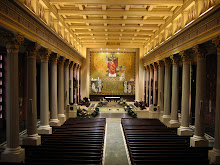
Delievered at St. Mary's of the Woods, Russell's Point, Archdiocese of Cincinnati.
On Christmas, it is easy to focus on the Manger scene, after all, I think it is one of the most tender images we have in Christendom: The Child, Mary, Joseph and the shepherds in a peaceful scene, snow falling (at least in my image); it all adds up for a heart warming image.
Yet, I would like to focus this year not on the ‘how’ of Jesus’ coming, but more the ‘why.’ What we recognize, and where the readings all point, is that all of history was leading up to this point. But why did it have to happen?
Since Adam and Eve, a gulf had existed between God and humanity, which the whole of salvation history had as the goal of overcoming. The Covenant of Abraham, the Law through Moses, the leadership of the Judges and Kings, and the call to repentance of the Prophets all had the goal of restoring the relationship broken with Original Sin, yet it never worked. The chasm was too great, it could not be overcome by ‘normal means.’
Why not? Why could we not overcome it on our own? Obviously, sin blocks the path. The distortions from sin do not allow us to see straight, as God would like us to do. This sin is not just the original sin, but also our own participation through personal sin. Here, we follow the sins of our ancestors, mostly in falling to Pride. It seems to me that in the Old Testament, God was always approached through pride, out of a quest for vainglory and power. He responded: the GloryCloud was God intervening directly in history, but through ways that the people of the time expected.
This pride and desire for vainglory also formed the expectation for the Messiah, for He would come to reestablish Israel as an independent country, the country which the rest of the world would serve.
Into the midst of this expectation, Jesus comes in a manger. The Messiah, the savior of the world, is not born in a palace with kings and queens present to worship and adore. Rather, he comes in a manger, in a small town, with only an ox and a donkey to greet him.
This becomes the key to His mission: not power, but HUMILITY.
The Second Reading for the Mass during the Day, from the Letter to the Hebrews, reflects on this reality. The Divine Second Person of the Trinity, He who is the Word Made Flesh, the one who ordered all of creation, does not come in that power, but leaves it all behind to come as a child. He freely lays that aside to become a man like us in all things but sin.
Only in Christianity is there such a mystery, would such a statement ever be echoed: ‘God so loved the world that He sent His Only Begotten Son to be our Savior.’ In Judaism and Islam, God is master, we are servants. In Eastern Religions, Nirvana is emptiness, not union with the Divine. In the Greco-Roman Pagan religions, you really just hoped the gods left you alone.
Yet, in Christianity, we see that God so desires for us to be reunited with Himself that He comes down to earth so that He might lift us back, not just to an earthly paradise, but a heavenly one.
What we must learn, however, is that how God deals with us, we must pay back to God. This is the flip of the approach between the Old Testament and the New.
No longer do we approach God in fear and trembling (although that should be a part of our approach), in the New, we come in humility and emptiness, offering our gifts to God to use as He will.
Hence, as we gather on these Christmas days, sharing gifts with one another as expressions of love for one another, let us also recognize those gifts that God has given, those unique talents and abilities that are personal to each one of us.
Not just to focus on those gifts, but to also recognize how God is asking us to share those gifts with our families, the Church, and the world.
Then, Christ will be revealed not just as a small child on Christmas day, but every thought, word and deed uttered by those who claim the name Christian will continue to bear Christ to the world.
Then, we will echo John the Baptist: He must increase, I must decrease.
Then, we will have a place not just here, but in that Heavenly Paradise He came to establish.
Showing posts with label homily. Show all posts
Showing posts with label homily. Show all posts
Saturday, December 25, 2010

Tuesday, October 26, 2010
Ephesians 5 at the Seminary
Today was, I believe, the first time I had the opportunity to preach the community Mass at Bishop Simon Brute College Seminary in Indianapolis, where we currently have 7 men in formation. Archbishop Schnurr and I made our fall visit there over the last few days. As he prefers to preach 'every-other' time he visits, and the guys 'hear us all the time' (said the rector), lot fell to me to preach on that reading, reproduced (kinda) as follows:
This is one of 'Those' passages which is easy to dismiss as out of date, dictated simply by the age and milieu in which Paul lived and wrote, and no longer has any validity for today.
While it is easy to do so, it is not wise to do so. 2 Timothy 3:16 states that All Scripture is inspired by God and necessary for salvation (paraphrase), so we can't simply dismiss this as out of hand, we have to make sense of it, otherwise we might lose our salvation if we cannot grasp fully the meaning of this passage and present it for our people, today.
There is a distinction to be made, here. Prior to Mass, I saw one of the guys reading Pope Benedict XVI's 'Jesus of Nazareth.' While it is a phenomenal work of meditation on the Scripture, a Catholic can honestly disagree with what the Holy Father has written. (Not that it would be wise to do so, but it is simply his personal reflection for the face of Jesus. It is not necessary for Salvation as Scripture is.)
We cannot simply discount what is in Scripture because it is hard, or difficult, or uncomfortable, or 'dated.' We must examine it carefully to make sense of how this particular passage makes sense, even today; and not just in an allegorical or typological way; but as it is actually written.
So: wives are to be submissive to their husbands, so says St. Paul.
In reading any Biblical quote, as a Catholic, we place the verse in context. The initial verse of this Reading gives us a frame of reference in how to interpret this verse: be subject to one another out of reverence for Christ! St. Paul is drawing an analogy between our relationship with Christ and the relationship between a husband and wife. (In the spiritual masters, the soul is always presented as a feminine before the face of God; even for men.) (If I had more time, I would have gone down through the passage as well, I will come back to this later, too.)
Another key tool in interpreting a difficult passage is to see what the Church, in her wisdom, has said about a particular passage throughout history. I have only been alive for 33 years, not even a drop in the ocean to the Church's 2,000 year history of thought and development.
Of particular note for this passage is Pope Pius XI's Casti Connubii (1930), his encyclical on Christian Marriage. In this Encyclical, the Holy Father notes that this passage 'does not oblige her to yield indiscriminately to all desires of her husband, which may be unreasonable or incompatible wtih her wifely dignity.' He continues that while this passage from Paul stresses the authority of the household rests in the husband, the heart of the household rests with the wife. Once again, we note the complimentarity of spouses, even long before Pope John Paul II's Theology of the Body.
Hence, we see the submission of the wife to the husband is tempered by his love for her, even as Christ loved his spouse, the Church. Jesus does not just talk about love, He shows it by laying his life down completely, to the last drop of His Blood so that she (the Church) might have life, and life abundantly. The husband is to do the same for his wife: give of himself completely, to die to his own desires and carnal pursuits so that he might hold her up as an image of Jesus' spotless bride in the Church. On a purely natural level, this is impossible (look at our culture, today). On a spiritual level, is it not only possible, but fruitful!
By looking at the roll of the husband in marriage, as outlined in this passage, we are then also able to apply this passage to our lives as priests and seminarians (God-willing: future priests). A husband who truly loves his wife more than himself will gladly sacrifice all that he is and has so that she might live life to its fullness. In his love for her, she becomes his all and he desires most of all to see her enter heaven.
As priests, we lay down our life so that our bride, the Church, might have life as well. When we as preists (or future-priests) have a deep and profound love for the Church, the sacrifice is easy. Yes, it is true that priests give up much; but we truly do receive so much more than we sacrifice, that the sacrifice becomes a joy and a burden that is easy and light.
When we come to a passage that is difficult; don't just dismiss it out of hand, but read it from the heart of the Church and in the heart of Christ; then we will be true and effective agents of salvation, as we have been called to be by Christ himself.
Saturday, November 15, 2008
Funeral Homily for Edward L. Dietz
From the foundations of this country as a mainly Protestant country, there has always been an underlying current that wants to separate holiness from happiness. From our study of American History, we learn about the Puritans who banished dancing and all seeming enjoyment. The Quakers were ‘quietists’ who sought to eliminate any type of emotionalism to have a ‘pure’ religious experience. These two factors, plus many others, eventually lead to Prohibition, the outlawing of all alcohol outside of religious use in this country; absolutely horrifying for someone of German descent!
It is something that still exists today in Pop Culture, as those who are presented as ‘holy’ are usually also presented as ‘dour.’ They have no fun, they are always serious, there is never enjoyment to be found, rather they spend all of their time on the knees in reparation for sins.
It does not take long for anyone who has known my Grandfather, even for the shortest amount of time, to recognize that this is not who he was. Over the last few days, after Grandpa passed on, the one comment that always comes to the fore about Grandpa: “He was quick with a joke.” Seemingly, he never met a joke he didn’t like, and he was always on the lookout for an unsuspecting new acquaintance on whom he could pull out the old stand-bys, in addition to the latest he heard from where ever. For his grandchildren, this was always a nerve-wracking position as we introduced an unsuspecting girlfriend or boyfriend for the first time at a family gathering. Grandpa would get this sly little look on his face, slowly slide over by the neophyte, and unleash a torrent of his recent favorites. The appropriate grandchild would dutifully role his or her eyes and want to climb into a hole somewhere, embarrassed.
But, grandpa’s love for jokes was not self serving; he never did it to bring attention to himself, but used this great love for humor to make others feel welcome and at home. He could take a tense and anxious situation and bring a relaxing calm to all present. What a wonderful gift that is to be able to share with so many, friends and family alike. And what a wonderful way to acknowledge the Love that God has for each one of us through the mystery and gift of laughter. As Fr. Pat led us through the discussion about Grandpa the other day, this was the idea that Jim, Larry, Mom, Diane, Mark and Lora all kept coming back to: Grandpa used the jokes to break down barriers, to establish friendships, and make people feel at ease.
While this love of humor was certainly one Grandpa’s most public aspects, it was not the deepest aspect of who he was. Being a farmer, something which never leaves the blood, is a great lesson in the trusting in the deep providence of God in all things. The family was reminiscing how during planting time, Grandpa was always testy, anxious for the coming year and how the crops would turn out. This deep reliance on the providence of God, though, was expressed in many ways. I remember learning to serve at morning Masses here at Immaculate Conception, and Grandma and Grandpa were always sitting in the same pew, praying the rosary, saying their prayers after Mass. Just as prayer marked the rhythm of life in a monastery, prayer was what marked the rhythm of life for grandma and grandpa, and very little would stand in his way. In fact, so important was Sunday Mass, that at one point the farm was snowed in. Even though he felt it was too dangerous for the children to come into town for Mass, he walked both ways so that he would not miss his Sunday obligation. (Either that, or he was tired of being cooped up with Jim and Larry, and decided a walk through several feet of snow was a good thing!)
As it is for so many who work the land and rely on the Providence of God to survive, prayer was something real, something personal, something powerful, and any opportunity to steal a moment in prayer was taken advantage of. Grandma related on Thursday that he would often pray a rosary while either planting or plowing, bragging often: I got two full rosaries in today! (As an aside, this is much better than Uncle Larry’s option of falling asleep at the wheel of the tractor!)
One final aspect that cannot be skipped over is his devotion to his family. While his was not a love that was worn on the sleeve, the love and concern that he had for his family was something that was always present, guiding how he treated his children, grandchildren and now great-grandchildren. Family was always important and he was generous in his own way. While for many years, all you would receive is a hearty handshake and a firm ‘yep!’, his devotion to grandma, especially in their years of retirement, is an example to us, his friends and descendents.
The legacy that he passes on to us continues these three themes: humor as a way of inviting others into relationship, faith, and family. Through all of this, his dedication and hard work provide the blue-print to a success that is not measured in dollars, but is measured in friends. Last night, as we were leaving the funeral home after the visitation, I thought of the funerals I have had for those in their 90’s. The crowds tend to be small, a few friends who are remaining, family scattered about. Grandpa, as he did with so many things, greatly exceeded expectations. So many friends, so many family members (many of whom I did not even know!), came to pay respects for a man who was deeply loved and respected, who enjoyed his life, but also had a deep and profound faith.
And the common consensus was: where are we going to get our jokes now?
Tuesday, August 26, 2008
A Word on Homilies
Something for my priest buddies to discuss, mayhaps?
Suggestions
Despite its complexity, Father Viganò pointed out two important aspects to ensure that a homily achieves its communicative objective: the consistency of the preacher's life and the brevity and concreteness of the message.
Quoting a phrase of St. Bernardine of Siena, patron of advertisers, the priest emphasized that the key lies in the clarity of the homily. "The preacher must speak very, very clearly, so that the listener will leave satisfied and illumined, and not dazzled."
In regard to consistency, the author recalled a phrase from philosopher Soren Kierkegaard, who said that "the difference between a pastor and an actor is precisely the existential moment: The pastor must be poor when he preaches about poverty; he must be slandered when he exhorts to endurance in slander. While the actor has the task of deceiving by eliminating the existential moment, the preacher in fact has the duty, in the most profound sense, to preach with his own life."
In regard to brevity, the priest explained that it is a question of avoiding both "non-existent homilies" as well as "endless homilies."
"St. Francis," Father Viganò recalled "exhorted his friars to use pondered and chaste words in their preaching, for the usefulness and edification of the people, proclaiming to the faithful the vices and virtues, the punishment and glory, with a brief speech, because on earth the Lord spoke brief words."
Tip to Joe Waters at Intentional Disciples
Friday, May 23, 2008
Cafeteria Catholicism and Vocations
Homily for Mass for the Renewal of the Priesthood and Vocations
Fourth Friday of every month
Our Lady of the Holy Spirit Center
Cafeteria Catholicism and Vocations
Over the last few decades, really since even before I was alive, there has been a rise in so called ‘Cafeteria Catholicism.’ There is an argument in some circles that ‘The Church can’t really tell me what to do in all aspects of my life!’ Slowly, aspects of the Church’s teaching that truly are constitutive start to be eroded by a desire to have an easy life, instead of a desire to have a holy life.
As this trend has increased, it moved from a wide acceptance by Catholics of artificial means of birth control (contraceptives) all the way down to a so-called ‘Vacation Exemption,’ where it is commonly held that if you are on vacation, you don’t have to attend Mass. (Believe me, I’ve searched for that one in Canon Law, and haven’t found it!) As even little rejections of aspects of the teaching authority in the Church start to infiltrate the lives of even good Catholics, we approach a very slippery slope to where, eventually, everything is rejected and the practice of the Faith is a ‘do what feels good’ or ‘God doesn’t really care about that, does He?’
It plays out in interesting ways. Before I was appointed as Vocation Director, I spent two years teaching at the high school level. Every once in a while, we would come across a point of doctrine, say the Real Presence of Christ in the Eucharist as we covered John 6, sort of a key aspect of Catholic doctrine, and the students would look back at me and respond: ‘Well, that’s what you believe, but don’t expect us to believe that as well.’
In ten years of Catholic education, they had never met anyone who bought the whole system and presented it as a coherent whole, that to reject one aspect of it was to reject the whole thing. So, when they come to the statement “You can’t be both Catholic and Pro-Choice,’ for example; because of the relativism that they have been formed in, they think that they are able to hold both.
Into this void, we have Jesus’ teaching on marriage. Certainly, He does not subscribe to the ‘take the easier of the two roads’ theory of Catholicism! Rather, he challenges us to the maximum, to die to self to live for the other. And in fact, with the teachings that we hear in our Gospel today, along with the great Letter of James, one of the things that Jesus exhorts, I think, is that the family become a model of holiness, a model of authenticity, a model of faithfulness to Christ, and hence then also to the Church.
It is not a secret: good priests come from good families. And while certainly there are good priests that come out of very broken and damaged families, it is much more difficult for sons of these families to make it through the seminary.
So, help your families (or the families of your grown children) to become the basic building block of not only the Church, but also society. As James indicates today, be a home of integrity, a home of honesty. Form those whom you come into contact with to be outstanding Catholic Christians in the world.
The secret to fostering vocations does not begin with some program that the Vocation Office runs. It starts in the home, where the full teachings of the Church are practiced, where respect is given to the priest and bishop, where prayer is integral to the daily life of the family.
Then, when your sons or daughters begin to look at career options, priesthood or religious life is instilled in them as viable, worthwhile, fruitful options, and they will be open to it if God so calls them in that direction.
As families, live a life of holiness, seek to model that holiness consistently and completely, be examples of generosity; and encourage your children (or grandchildren) to do the same. Then vocations will flourish.
Friday, April 25, 2008
Feast of St. Mark Homily
St. Mark is one of those figures from the Early Church where most of what we know about him is speculation, or has been transmitted down through history in an almost mythical way. However, that is not to say that it is not accurate, we just do not have some of the sure details that we, as 21st Century Americans, like to have.
This speculation, or these indications, from history include the following points:
1) He was not part of the original Twelve Apostles, rather it seems that he is a native of Jerusalem and it is speculated that it was his house that was used as the meeting place for the Last Supper; he was likely a teenager at the time.
2) During the Passion Narrative, there is one curious figure who appears: “Now a young man followed him wearing nothing but a linen cloth about his body. They seized him, but he left the cloth behind and ran off naked." (Mark 14:51-52) This singular young man is speculated to be the future evangelist, and lends credence that the Last Supper was held at his place, and he sort of ‘snuck out’ to join Jesus and the Twelve during their night of prayer.
3) Finally, there is a figure who appears periodically in the Acts of the Apostles, and we’ve just heard about him over the last weeks: John Mark. Again, there is ancient testimony that links this man with this Evangelist. This John Mark is a some-time companion with Paul and Barnabbas, especially during their first missionary journey to Asia Minor. However, it seems that the persecution that they were facing was too much for him at the time and he had to leave Paul’s side and returned, apparently, to Jerusalem where he joined up with Peter. This final detail is important because as Paul and Barnabbas were preparing to go on their second journey, Barnabbas wanted to bring John Mark with them; but Paul refused because he had deserted them once and was fearful that he would desert them again.
Now, these points of history are certainly interesting from the historical point of view and give us some of the intriguing story lines from the early church, but they also have some impact in what we have gathered here today to celebrate and prayer for: perseverance of priests and an increase in more vocations.
The first point relates to the fostering of Vocations. The young evangelist is home, when the preparations begin for an unexpected visitor. (Is he the ‘certain man’ Jesus’ Apostle’s were sent to find?) This unexpected encounter leads to a thirst to get to know Our Lord better, apparently even leading him to sneak out of the house to join with this band of men. He aspires to join with them, he aspires to be near to Our Lord. His life is changed forever from this one encounter.
For today, we have to help our young people to have that same desire to ‘be with Jesus.’ He is the one who opens the heart to call to follow, a radical call to discipleship. His presence is the one that changes the path of life forever. Yet, our young people of today often do not have the witness of the older generation, of their parents, of having a radical discipleship with Jesus. Hence the need to model that ourselves: first the priests, but also among the family. Is the family a house of prayer, ready to welcome Our Lord should he be passing by the way?
Second, for some, this encounter with Our Lord is a unique call to leave it all behind to follow after Jesus. Here, in the case of St. Mark, he apparently gets up in the middle of the night and goes forth wearing only a cloth. He follows Jesus out into the Garden; he leaves behind his family and the life he has known. On this night, he experiences the first challenge in response to discipleship: the possibility of arrest. This was a counter-cultural movement, one that placed him at odds with the established government and culture at the time. It does not take much examination of the wider culture to recognize we are in a similar situation today.
Often when I meet with a potential candidate for the first time, I ask about the potential challenges he faces. Family support is often mentioned, but also the demands that the wider culture and his peer support seem to go against his response. He is nearly trapped by the expectations for money, the rampant sexualization of the culture, and the challenge ‘to be successful.’ Admittedly, some do get grabbed by these traps and fall away from the potential call to the priesthood. Hence the importance of prayer for the perseverance of vocations, the perseverance of those called that they can give everything to follow Jesus. Just as John Mark was nearly overwhelmed by these demands, so are so many of those who have a potential to be excellent priests and religious.
Finally, the demands placed upon those who ‘make it through to completion’ and are ordained as priests are many, varied, and difficult. Often, through the demands of obedience we are placed in situations that are not of our own choosing, just as John Mark was elected and joined with St. Paul in the initial stages of his journeys throughout the then known world. Sometimes it can be overwhelming for the man, and he experiences the need to step away, as John Mark did. This can be catastrophic for the man who desires to give more, yet is feeling some reluctance, a reluctance that he may not even be able to articulate and clarify. Why did St. Mark leave Paul and Barnabbas? We will never know. What we do know is that it did cause further division and strife. This can be exceedingly difficult to overcome, and has a lasting impact, as it did between Mark and Paul.
Yet, in the midst of this and ‘the rest of the story’ is that Mark did not give up, but saw this as a new path, a new direction in his journey. After he left Paul, there is a vein of history that says that he joined up with St. Peter, and that the Gospel according to Mark is also the Gospel according to Peter: Mark becomes Peter’s stenographer, as it were, giving us this image of Jesus on fire with preaching, moving from event to event eager to spread the message that the Father had given him. Interesting. What would have happened had Mark given up after his dismissal from Paul? We might not have this depiction of Jesus as the roaring lion of Judah, as presented in this shortest of canonical Gospels.
Hence the final application for today: prayer for your priests. We are often asked for things that we have no training for; demands are placed upon us which seem to be above and beyond what we are capable of. Sadly, sometimes we fail to meet these expectations and it can cause a crisis of faith, a struggle to follow our Lord, yet knowing that I am a sinner in need of redemption. There can be a constant struggle within the priest that he is an agent of salvation for others, yet also in need of that salvation himself. Your prayers and support for the priest, for your priest, can make a world of difference to this man. On a personal note, I fondly remember those 6:30 AM Masses before I would head off to teach for the day as I was first ordained. Having a crowd of 60, 80, even 100 of the faithful gathered to begin their day in worship and prayer of Our Lord energized me, allowed me to look forward to spending my day at the high school, bringing Christ with me as I went. I thank them for this one particular blessing. And as I work now as Vocation Director, I have come to know all the more that a happy priest is the best recruiter for more priests: help you priest to be happy!
In closing, what are the steps we need to take at this point in history? I think they are simple, yet profound; easy to begin, yet hard to bring to fruition:
First: introduce our young people to Our Lord, especially in the Blessed Sacrament; in the context of the Church; among the faithful.
Second: prayer for vocations, our Holy Father reminded us of the great importance of prayer in this endeavor during his address to the Bishops of our country. The call to a vocation is difficult to respond to, is difficult to even hear; pray that those who are being called can respond generously to this invitation.
Finally: support, not only our seminarians, but also the priests you know. Support them through your prayers, again, but also through the acts of kindness and charity. We so often only hear the bad news: someone who has a bone to pick with a homily we have given, questions as to why we missed a particular meeting; why we haven’t done more to support the school, etc. It is nice to hear that a homily has been well received and that the faithful have heard the challenge given in a loving, yet direct way.
I am convinced that we are on the cusp of a great tide in vocations to the priesthood, religious and consecrated life; yet we need the support of all the faithful that this tide not be missed. Thank you for your continued prayers for my ministry, and please be assured of my prayers for you.
Thursday, June 21, 2007
Radio Ga Ga, part II
I was on the schedule again this week to tape the homily for "The Gospel Today" on Sacred Heart Radio.
You can listen online, and it plays 7:30 and 11:30 Saturday and Sunday mornings.
(Text will appear later this week, don't want to ruin the surprise ;) )
Subscribe to:
Posts (Atom)


 Posts