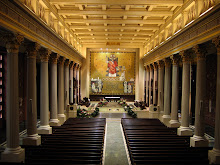
Appearing in this week’s edition of the Catholic Telegraph:
As I mentioned in my last article, the Ordination of Priests is a unique and special event in the life of a diocese. As a priest, and now as Vocation Director, it is an even more unique event as men that I have worked with are presented before the Archbishop to take a unique role of service and leadership in the Church. While the entire ceremony is of special value, I want to focus on three sections of the Ordination Mass: the calling of the candidates, the Litany of Saints, and the Laying on of Hands.
Before a candidate is ordained, he is called forward by the deacon and presented to the Archbishop by the rector of the seminary. At priesthood ordination, he sits in the sanctuary of the Cathedral before this call. The better version of this actually happens at the Ordination of Deacons, where the candidates sit with their families up to this section, which immediately follows the Proclamation of the Gospel. By doing so, the Church shows that formation for the priesthood begins long before a candidate even enters the seminary. He is shaped by the experiences he had growing up in a loving Christian family, where God was already molding this candidate. By sitting with his family, the candidate also says thanks for the gifts that he has received from them. He is still a part of that family, but now he will be part of much larger family as well.
After the candidate is called forward and questioned by the ordaining bishop; this larger family comes to the forefront during the Litany of the Saints. The men being ordained submit themselves and lay prostrate before the altar of God in a profound sign of humility. Before they lay down, they are just other men; when they rise, they are priests. They have left their own ambitions at the foot of the altar and have taken on the mantle of Christ. If they were doing this on their own, it would be impossible. But as we hear these many saints, men and women who have gone before us and earned the Crown of Victory, we realize that there are many paths to holiness. We realize that many before us have walked this road, and they are still present to be a guide and model for us today. Whenever I talk to someone immediately after their first time attending an Ordination Mass, this is nearly always the most profound aspect of their experience. It helps us all to realize that we are never alone. The saints are present here as our guides and teachers.
A further sign of the connection that a new priest has in the community comes with the Laying on of Hands. This is the ancient symbol used to confer the Sacrament of Holy Orders, as is mentioned in the Acts of the Apostles. In the Ordination of Priests, it is not just the ordaining bishop who lays his hands on the newly formed priests, all the priests present also confer this sign to their new brothers. As I stood watching my brother priests conferring this wonderful sign on our new brothers, I was struck by how each priest passes on a unique gift, a unique aspect of the priesthood to the newly ordained: a gift of healing, a gift of preaching, a gift for administration, one for compassion, etc. Priests are not homogenized, ‘one size fits all’ units, each priest has his own way of showing Christ’s presence in the world.
Looking back on the three men just ordained, and looking forward to many more in the coming years, I truly feel that the Mass of Ordination of Priests is something that every Catholic should experience at least once in their life. In the life of a diocese, this Mass is a unique sign of hope in the future, a sign of the vitality of the local church, and most of all a ceremony that is rife with joy, as we send three new priests into the vineyards of the Lord.
For more information on the priesthood and seminary, please visit Vocation Office Webpage.
Showing posts with label Holy Orders. Show all posts
Showing posts with label Holy Orders. Show all posts
Thursday, June 7, 2007

Thursday, April 19, 2007
Holy Orders
My newest article in the Catholic Telegraph, which hits the mailboxes today:
As winter fades and spring starts to melt into summer, there are a great many events to celebrate in our local Church; first among these is the great celebration of our Salvation won by Christ in the mystery of Holy Week and Easter. With this celebration, we welcomed nearly 1,200 new converts into the fold of the Catholic Church, just here in our Archdiocese. There is no greater celebration during the Church year.
However, there are two other great ceremonies that are celebrated this time of year which rival the beauty of the Easter Vigil, especially for me as a priest: Ordinations to the Diaconate and to the Priesthood, the Sacrament where men are configured to be more like Christ in service to His Bride, the Church. Like Baptism and Confirmation, Holy Orders is a non-repeatable sacrament: once you are ordained, you are a priest forever. However, it is also unique in that it is entered through a series of three steps, or levels. Hence the name Orders, for this Sacrament is the foundation for the structure of how Christ constructed His Church.
This break down is not accidental, but a purposeful orientation for the man who presents himself to the Church for priesthood. He does not begin his priesthood seated on a throne in glory, rather his ordained life begins with service as a deacon. The very word means “servant” in Greek. For some, this is a permanent state, the Permanent Diaconate. The men ordained to this level live a life marked in service to God and to the parish they are assigned, the world in which they live and the marketplace where they work. Having worked with a few of these men, they are great assets and aids to the pastor. For men who are on the way towards priesthood, transitional deacons, their participation in the Order of Deacon forms them in a life of service and of giving themselves completely for the life of the Church. It is a formation in the command of Christ: “No one has greater love than this, to lay down one’s life for one’s friends (Jn 15:13).”
The second order within ‘Holy Orders’ is the priesthood. The service that a man began in his life as a deacon models and shapes his life as a priest. No one is a priest for himself, rather he is oriented to love the people of God to whom he has been sent. A priest is a man for others. His mission is to help and lead his congregation (his family) to grow in holiness. Especially today, this cannot be imposed upon a parish; it must first be modeled by the priest himself, and then given to his people. At his ordination, a priest is commissioned to imitate the Sacraments that he celebrates, so that he too can be a living Icon present in the world – a Living Icon of the Eternal Priesthood of Jesus Christ.
Finally, a select few are admitted to the third and final Order within the Church’s structure: Episcopacy, the Order of Bishops. This order is the fullness of the priesthood within the Church, and all priests exercise their ministry in unity with their bishop. It is the bishop who exercises his priestly role in leadership, unifying the diocese under his care, being a steward of the treasures of the diocese so that the Gospel can be preached in all of its wonder. The Order of Bishops is the direct descendant of the Apostles, through the Laying on of Hands. We find testimony to this even as far back as the early Second Century in the writings of St. Ignatius of Antioch, who states: “You must all follow the bishop as Jesus Christ follows the Father.”
As the two celebrations of ordination approach, it is important to keep in mind that no man is ordained for himself, rather he becomes the bridegroom – the Alter Christus, and he gives his life to the Church, his bride, just as all husbands are called to love their wives like Christ loves the Church: unto death. A man does this as a priest so that we may all have access to the Sacraments and may all attain the salvation won for us by Christ.
As winter fades and spring starts to melt into summer, there are a great many events to celebrate in our local Church; first among these is the great celebration of our Salvation won by Christ in the mystery of Holy Week and Easter. With this celebration, we welcomed nearly 1,200 new converts into the fold of the Catholic Church, just here in our Archdiocese. There is no greater celebration during the Church year.
However, there are two other great ceremonies that are celebrated this time of year which rival the beauty of the Easter Vigil, especially for me as a priest: Ordinations to the Diaconate and to the Priesthood, the Sacrament where men are configured to be more like Christ in service to His Bride, the Church. Like Baptism and Confirmation, Holy Orders is a non-repeatable sacrament: once you are ordained, you are a priest forever. However, it is also unique in that it is entered through a series of three steps, or levels. Hence the name Orders, for this Sacrament is the foundation for the structure of how Christ constructed His Church.
This break down is not accidental, but a purposeful orientation for the man who presents himself to the Church for priesthood. He does not begin his priesthood seated on a throne in glory, rather his ordained life begins with service as a deacon. The very word means “servant” in Greek. For some, this is a permanent state, the Permanent Diaconate. The men ordained to this level live a life marked in service to God and to the parish they are assigned, the world in which they live and the marketplace where they work. Having worked with a few of these men, they are great assets and aids to the pastor. For men who are on the way towards priesthood, transitional deacons, their participation in the Order of Deacon forms them in a life of service and of giving themselves completely for the life of the Church. It is a formation in the command of Christ: “No one has greater love than this, to lay down one’s life for one’s friends (Jn 15:13).”
The second order within ‘Holy Orders’ is the priesthood. The service that a man began in his life as a deacon models and shapes his life as a priest. No one is a priest for himself, rather he is oriented to love the people of God to whom he has been sent. A priest is a man for others. His mission is to help and lead his congregation (his family) to grow in holiness. Especially today, this cannot be imposed upon a parish; it must first be modeled by the priest himself, and then given to his people. At his ordination, a priest is commissioned to imitate the Sacraments that he celebrates, so that he too can be a living Icon present in the world – a Living Icon of the Eternal Priesthood of Jesus Christ.
Finally, a select few are admitted to the third and final Order within the Church’s structure: Episcopacy, the Order of Bishops. This order is the fullness of the priesthood within the Church, and all priests exercise their ministry in unity with their bishop. It is the bishop who exercises his priestly role in leadership, unifying the diocese under his care, being a steward of the treasures of the diocese so that the Gospel can be preached in all of its wonder. The Order of Bishops is the direct descendant of the Apostles, through the Laying on of Hands. We find testimony to this even as far back as the early Second Century in the writings of St. Ignatius of Antioch, who states: “You must all follow the bishop as Jesus Christ follows the Father.”
As the two celebrations of ordination approach, it is important to keep in mind that no man is ordained for himself, rather he becomes the bridegroom – the Alter Christus, and he gives his life to the Church, his bride, just as all husbands are called to love their wives like Christ loves the Church: unto death. A man does this as a priest so that we may all have access to the Sacraments and may all attain the salvation won for us by Christ.
Subscribe to:
Posts (Atom)


 Posts
Posts