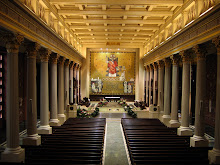
www.seekholiness.com (Vocation Office of the Diocese of Columbus, Ohio) continues to produce and release great videos on male spirituality and how it relates both to men seeking the priesthood and men living in the lay state. This one was particularly good:
Showing posts with label male priesthood. Show all posts
Showing posts with label male priesthood. Show all posts
Monday, May 10, 2010

Wednesday, June 4, 2008
A different approach,
same conclusion:
A Sociologist on Women's Ordination from Inside Catholic
For if women were to be ordained, they would soon -- within 50 years, I'd guess -- become overwhelmingly predominant in the priesthood. Female priests would outnumber male priests by ten or 20 to one, if not more. Catholicism would be perceived, and correctly so, not just as a "feminine" religion but as a female religion. Males would pretty much abandon it.
A Sociologist on Women's Ordination from Inside Catholic
For if women were to be ordained, they would soon -- within 50 years, I'd guess -- become overwhelmingly predominant in the priesthood. Female priests would outnumber male priests by ten or 20 to one, if not more. Catholicism would be perceived, and correctly so, not just as a "feminine" religion but as a female religion. Males would pretty much abandon it.
Sunday, June 1, 2008
My reply
to this post was submitted to the Enquirer tonight:
In her column, Heidi Bright Parales (Anti-female priests decree not based on Bible, May 31) commits a common, but serious flaw: she ignores the distinction between the discipleship demanded by all Christians versus the ministerial priesthood bestowed upon the Twelve Apostles during the Last Supper.
All disciples have an obligation to make Christ known through the witness of their lives: Mary Magdalene did in the post-Resurrection accounts in the Gospels; Mary, the Mother of the Lord, did in the Nativity narrative; and Peter, John, and Paul, and many others, did throughout the Acts of the Apostles.
However, this commission to go forth and preach is quite different from the obligations given to those chosen for a special ministry and passed on through prayer and the laying on of hands: the Twelve Apostles. Throughout the Gospels and the New Testament, there is a distinction between these two groups: the call of the general disciple and the call of the ordained priest who has been set aside and anointed with the authority to stand in for Christ in the administration of the sacraments.
The deeper issue remains unaddressed. The call to ordained priesthood is not a call to power or authority, these are gifts granted to the priest; but the call is one of service and love, following Our Lord’s commission that ‘no one has greater love than this, to lay down one’s life for one’s friends.’ The priesthood is to be embraced in humility, and the man called is to sacrifice himself for his people as Jesus did on the Cross. Those Twelve men are to give their lives for the rest of the community, a call which continues to today.
For more information, see http://www.cincinnativocations.org/who_faqs.shtml
Fr. Kyle Schnippel is Vocation Director for the Archdiocese of Cincinnati.
In her column, Heidi Bright Parales (Anti-female priests decree not based on Bible, May 31) commits a common, but serious flaw: she ignores the distinction between the discipleship demanded by all Christians versus the ministerial priesthood bestowed upon the Twelve Apostles during the Last Supper.
All disciples have an obligation to make Christ known through the witness of their lives: Mary Magdalene did in the post-Resurrection accounts in the Gospels; Mary, the Mother of the Lord, did in the Nativity narrative; and Peter, John, and Paul, and many others, did throughout the Acts of the Apostles.
However, this commission to go forth and preach is quite different from the obligations given to those chosen for a special ministry and passed on through prayer and the laying on of hands: the Twelve Apostles. Throughout the Gospels and the New Testament, there is a distinction between these two groups: the call of the general disciple and the call of the ordained priest who has been set aside and anointed with the authority to stand in for Christ in the administration of the sacraments.
The deeper issue remains unaddressed. The call to ordained priesthood is not a call to power or authority, these are gifts granted to the priest; but the call is one of service and love, following Our Lord’s commission that ‘no one has greater love than this, to lay down one’s life for one’s friends.’ The priesthood is to be embraced in humility, and the man called is to sacrifice himself for his people as Jesus did on the Cross. Those Twelve men are to give their lives for the rest of the community, a call which continues to today.
For more information, see http://www.cincinnativocations.org/who_faqs.shtml
Fr. Kyle Schnippel is Vocation Director for the Archdiocese of Cincinnati.
Thursday, April 19, 2007
Holy Orders
My newest article in the Catholic Telegraph, which hits the mailboxes today:
As winter fades and spring starts to melt into summer, there are a great many events to celebrate in our local Church; first among these is the great celebration of our Salvation won by Christ in the mystery of Holy Week and Easter. With this celebration, we welcomed nearly 1,200 new converts into the fold of the Catholic Church, just here in our Archdiocese. There is no greater celebration during the Church year.
However, there are two other great ceremonies that are celebrated this time of year which rival the beauty of the Easter Vigil, especially for me as a priest: Ordinations to the Diaconate and to the Priesthood, the Sacrament where men are configured to be more like Christ in service to His Bride, the Church. Like Baptism and Confirmation, Holy Orders is a non-repeatable sacrament: once you are ordained, you are a priest forever. However, it is also unique in that it is entered through a series of three steps, or levels. Hence the name Orders, for this Sacrament is the foundation for the structure of how Christ constructed His Church.
This break down is not accidental, but a purposeful orientation for the man who presents himself to the Church for priesthood. He does not begin his priesthood seated on a throne in glory, rather his ordained life begins with service as a deacon. The very word means “servant” in Greek. For some, this is a permanent state, the Permanent Diaconate. The men ordained to this level live a life marked in service to God and to the parish they are assigned, the world in which they live and the marketplace where they work. Having worked with a few of these men, they are great assets and aids to the pastor. For men who are on the way towards priesthood, transitional deacons, their participation in the Order of Deacon forms them in a life of service and of giving themselves completely for the life of the Church. It is a formation in the command of Christ: “No one has greater love than this, to lay down one’s life for one’s friends (Jn 15:13).”
The second order within ‘Holy Orders’ is the priesthood. The service that a man began in his life as a deacon models and shapes his life as a priest. No one is a priest for himself, rather he is oriented to love the people of God to whom he has been sent. A priest is a man for others. His mission is to help and lead his congregation (his family) to grow in holiness. Especially today, this cannot be imposed upon a parish; it must first be modeled by the priest himself, and then given to his people. At his ordination, a priest is commissioned to imitate the Sacraments that he celebrates, so that he too can be a living Icon present in the world – a Living Icon of the Eternal Priesthood of Jesus Christ.
Finally, a select few are admitted to the third and final Order within the Church’s structure: Episcopacy, the Order of Bishops. This order is the fullness of the priesthood within the Church, and all priests exercise their ministry in unity with their bishop. It is the bishop who exercises his priestly role in leadership, unifying the diocese under his care, being a steward of the treasures of the diocese so that the Gospel can be preached in all of its wonder. The Order of Bishops is the direct descendant of the Apostles, through the Laying on of Hands. We find testimony to this even as far back as the early Second Century in the writings of St. Ignatius of Antioch, who states: “You must all follow the bishop as Jesus Christ follows the Father.”
As the two celebrations of ordination approach, it is important to keep in mind that no man is ordained for himself, rather he becomes the bridegroom – the Alter Christus, and he gives his life to the Church, his bride, just as all husbands are called to love their wives like Christ loves the Church: unto death. A man does this as a priest so that we may all have access to the Sacraments and may all attain the salvation won for us by Christ.
As winter fades and spring starts to melt into summer, there are a great many events to celebrate in our local Church; first among these is the great celebration of our Salvation won by Christ in the mystery of Holy Week and Easter. With this celebration, we welcomed nearly 1,200 new converts into the fold of the Catholic Church, just here in our Archdiocese. There is no greater celebration during the Church year.
However, there are two other great ceremonies that are celebrated this time of year which rival the beauty of the Easter Vigil, especially for me as a priest: Ordinations to the Diaconate and to the Priesthood, the Sacrament where men are configured to be more like Christ in service to His Bride, the Church. Like Baptism and Confirmation, Holy Orders is a non-repeatable sacrament: once you are ordained, you are a priest forever. However, it is also unique in that it is entered through a series of three steps, or levels. Hence the name Orders, for this Sacrament is the foundation for the structure of how Christ constructed His Church.
This break down is not accidental, but a purposeful orientation for the man who presents himself to the Church for priesthood. He does not begin his priesthood seated on a throne in glory, rather his ordained life begins with service as a deacon. The very word means “servant” in Greek. For some, this is a permanent state, the Permanent Diaconate. The men ordained to this level live a life marked in service to God and to the parish they are assigned, the world in which they live and the marketplace where they work. Having worked with a few of these men, they are great assets and aids to the pastor. For men who are on the way towards priesthood, transitional deacons, their participation in the Order of Deacon forms them in a life of service and of giving themselves completely for the life of the Church. It is a formation in the command of Christ: “No one has greater love than this, to lay down one’s life for one’s friends (Jn 15:13).”
The second order within ‘Holy Orders’ is the priesthood. The service that a man began in his life as a deacon models and shapes his life as a priest. No one is a priest for himself, rather he is oriented to love the people of God to whom he has been sent. A priest is a man for others. His mission is to help and lead his congregation (his family) to grow in holiness. Especially today, this cannot be imposed upon a parish; it must first be modeled by the priest himself, and then given to his people. At his ordination, a priest is commissioned to imitate the Sacraments that he celebrates, so that he too can be a living Icon present in the world – a Living Icon of the Eternal Priesthood of Jesus Christ.
Finally, a select few are admitted to the third and final Order within the Church’s structure: Episcopacy, the Order of Bishops. This order is the fullness of the priesthood within the Church, and all priests exercise their ministry in unity with their bishop. It is the bishop who exercises his priestly role in leadership, unifying the diocese under his care, being a steward of the treasures of the diocese so that the Gospel can be preached in all of its wonder. The Order of Bishops is the direct descendant of the Apostles, through the Laying on of Hands. We find testimony to this even as far back as the early Second Century in the writings of St. Ignatius of Antioch, who states: “You must all follow the bishop as Jesus Christ follows the Father.”
As the two celebrations of ordination approach, it is important to keep in mind that no man is ordained for himself, rather he becomes the bridegroom – the Alter Christus, and he gives his life to the Church, his bride, just as all husbands are called to love their wives like Christ loves the Church: unto death. A man does this as a priest so that we may all have access to the Sacraments and may all attain the salvation won for us by Christ.
Monday, March 5, 2007
Saturday, February 24, 2007
More thoughts on the Priesthood
Daniel Avila nails it in a recent article for The Pilot, of the Archdiocese of Boston. When challenged by the teaching of an all male, heirarchichal priesthood, instead of just blindly going along with the status quo, he looked it up! In reading the document he states:
It struck me upon reading these documents just how important sexual difference, and the anthropological reality of being human through two means, male and female, are to the Church’s sacramental understanding of the priesthood. As this column has indicated in the past, the same regard for sexual difference and the male and female identities plays a central role in the Church’s understanding of marriage and sexual attraction.
One of the elements of the teaching in “Inter Insigniores” is that holy orders, being a sacrament, must contain within it a sign that is “perceptible and which the faithful must be able to recognize with ease.” The Church understands the ministry of the priest to be the unique sign of Jesus, truly present. That is, “the bishop or the priest, in the exercise of his ministry, does not act in his own name; he represents Christ, who acts through him.” To be effective as supernatural signs, the sacraments must “represent what they signify by natural resemblance.” Jesus “was and remains a man.” Thus, the presence of Jesus in the priesthood is obscured in a fundamental respect if the priest is not also a man.
Now, if we could just get people here to read the document, it would do wonders.
It struck me upon reading these documents just how important sexual difference, and the anthropological reality of being human through two means, male and female, are to the Church’s sacramental understanding of the priesthood. As this column has indicated in the past, the same regard for sexual difference and the male and female identities plays a central role in the Church’s understanding of marriage and sexual attraction.
One of the elements of the teaching in “Inter Insigniores” is that holy orders, being a sacrament, must contain within it a sign that is “perceptible and which the faithful must be able to recognize with ease.” The Church understands the ministry of the priest to be the unique sign of Jesus, truly present. That is, “the bishop or the priest, in the exercise of his ministry, does not act in his own name; he represents Christ, who acts through him.” To be effective as supernatural signs, the sacraments must “represent what they signify by natural resemblance.” Jesus “was and remains a man.” Thus, the presence of Jesus in the priesthood is obscured in a fundamental respect if the priest is not also a man.
Now, if we could just get people here to read the document, it would do wonders.
Subscribe to:
Posts (Atom)


 Posts
Posts